

Introduction: What Is Digital Marketing?
If you have ever searched Google for a business, watched a product video on YouTube, clicked an Instagram advertisement, or received a promotional email, you have already experienced digital marketing.
But what exactly does it mean?
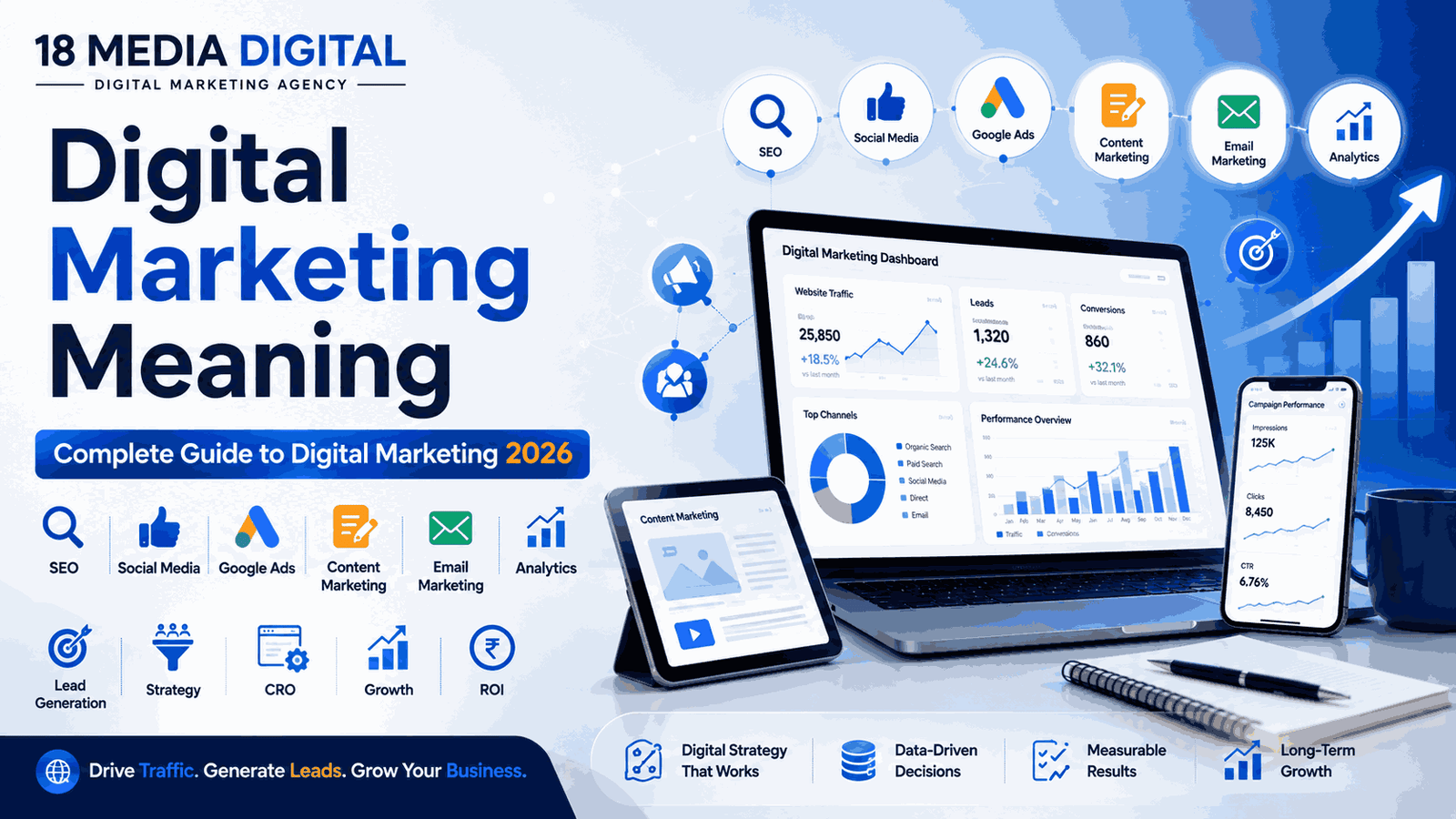
The Digital Marketing Meaning refers to the process of promoting products, services, brands, or businesses through digital channels such as search engines, websites, social media platforms, email, online advertising, mobile applications, and other internet-based platforms.
Understanding the Digital Marketing Meaning is important because digital marketing is not limited to advertisements or social media posts. It includes all online activities that help businesses attract potential customers, communicate with them, generate leads, and increase sales.
Unlike traditional marketing, digital marketing allows businesses to reach specific audiences, measure campaign performance, track customer behaviour, and optimize marketing activities based on real data.
For example, a local restaurant can use Google Search to attract people searching for “restaurants near me,” Instagram to showcase food, Meta Ads to target people in a specific location, and WhatsApp or email to maintain relationships with existing customers.
This example makes the Digital Marketing Meaning easier to understand because different online platforms can work together to move customers from awareness to purchase.
Digital marketing is therefore much more than simply posting on social media or running advertisements.
It is a complete customer-acquisition and growth system that connects businesses with people throughout the buying journey.
Digital Marketing Meaning: A Simple Definition
In simple terms, the Digital Marketing Meaning can be explained as marketing a business using digital technologies and online channels to attract, engage, convert, and retain customers.
A simple way to understand it is:
Digital Marketing = Reaching the right audience + delivering the right message + using the right digital channel + measuring the result.
For instance, imagine a company selling online courses.
Its digital marketing strategy could include:
- SEO to appear on Google for educational searches
- Content marketing to answer questions and build authority
- YouTube marketing to demonstrate expertise
- Instagram marketing to build awareness and engagement
- Google Ads to capture high-intent searches
- Email marketing to nurture leads
- Remarketing to reconnect with visitors who did not purchase
- Analytics to measure traffic, leads, conversions, and revenue
All these activities work together as part of a broader digital strategy.
Looking at these channels together helps explain the Digital Marketing Meaning in practical terms: businesses use multiple digital touchpoints to reach customers at different stages of their buying journey.
Why the Definition Matters for Businesses
Understanding digital marketing is important because customers increasingly use digital channels before making purchasing decisions.
According to DataReportal’s Digital 2026 India report, India had approximately 1.03 billion internet users at the end of 2025, representing around 70% of the country’s population. The report also recorded approximately 500 million social media user identities.
That creates a massive opportunity for businesses.
Whether a company is a startup, local service provider, e-commerce brand, B2B organization, educational institution, healthcare business, or professional service provider, its customers are likely interacting with digital platforms at multiple stages of their decision-making process.
For businesses, understanding the Digital Marketing Meaning also helps them choose the right channels, create better marketing strategies, measure ROI, generate qualified traffic, and turn online visibility into real business growth.ers are likely interacting with digital platforms at multiple stages of their decision-making process.
What Is Digital Marketing and How Does It Work?
Digital marketing generally works thrDigital marketing generally works through a customer journey. Understanding the Digital Marketing Meaning becomes easier when you look at how a potential customer discovers, researches, evaluates, and finally interacts with a business online.
A person may first discover a business through Google, see the brand again on Instagram, read a blog article, watch a YouTube video, compare competitors, and finally contact the company or make a purchase.
This journey can be divided into five major stages:
1. Awareness
At this stage, the potential customer may not know your business.
The goal is to increase visibility and introduce your brand to the right audience through:
- SEO
- Social media
- YouTube
- Display advertising
- Influencer marketing
- Content marketing
- Online PR
For example, a person searching for “best digital marketing agency in Pune” may discover a company through Google search results. This is one practical example of the Digital Marketing Meaning in action, where online visibility helps a business reach potential customers.
2. Interest
The customer becomes interested and starts researching.
At this stage, businesses need to provide useful information that answers questions and builds trust.
Useful content includes:
- Blog posts
- Guides
- Videos
- Case studies
- Comparisons
- Educational social media content
- Webinars
The objective is not simply to attract website traffic but to provide valuable information that helps the customer move closer to a purchasing decision.
3. Consideration
Now the customer is comparing different options.
Businesses can support this stage with:
- Product pages
- Service pages
- Testimonials
- Reviews
- Case studies
- Pricing information
- Demonstrations
- FAQs
At this point, customers are looking for reasons to choose one business over another. A strong website, clear value proposition, social proof, and relevant content can significantly influence their decision.
4. Conversion
The customer takes the desired action.
Examples include:
- Buying a product
- Filling out a form
- Calling a business
- Booking a consultation
- Downloading a resource
- Signing up for a service
Conversion is an important part of the Digital Marketing Meaning because successful online marketing should ultimately contribute to a measurable business outcome, such as a lead, sale, booking, or enquiry.
5. Retention
Digital marketing does not stop after conversion.
After someone becomes a customer, businesses can continue building the relationship through:
- Email marketing
- WhatsApp communication
- Loyalty campaigns
- Remarketing
- Personalized offers
- Customer support
- Educational content
Retention can encourage repeat purchases, improve customer loyalty, and increase customer lifetime value.
A Simple Example of the Digital Marketing Customer Journey
For instance, imagine a company selling online courses.
Its digital marketing strategy could include:
- SEO to appear on Google for educational searches
- Content marketing to answer questions and build authority
- YouTube marketing to demonstrate expertise
- Instagram marketing to build awareness and engagement
- Google Ads to capture high-intent searches
- Email marketing to nurture leads
- Remarketing to reconnect with visitors who did not purchase
- Analytics to measure traffic, leads, conversions, and revenue
All these activities work together as part of a broader digital strategy.
This complete journey—from discovering a brand to becoming a customer and eventually returning for another purchase—helps explain the Digital Marketing Meaning from a business perspective.
Why the Definition Matters for Businesses
Understanding digital marketing is important because customers increasingly use digital channels before making purchasing decisions.
According to DataReportal’s Digital 2026 India report, India had approximately 1.03 billion internet users at the end of 2025, representing around 70% of the country’s population. The report also recorded approximately 500 million social media user identities.
That creates a massive opportunity for businesses.
Whether a company is a startup, local service provider, e-commerce brand, B2B organization, educational institution, healthcare business, or professional service provider, its customers are likely interacting with digital platforms at multiple stages of their decision-making process.
For businesses, understanding these stages helps them create the right content, select appropriate marketing channels, improve conversion rates, and build a more effective digital strategy.
Key Components of Digital Marketing
Digital marketing consists of several specialized channels. Understanding the Digital Marketing Meaning also means understanding how these different channels work together to attract, engage, convert, and retain customers.
A successful strategy does not necessarily require every channel. Instead, businesses should select channels based on their audience, goals, industry, budget, and customer journey.
1. Search Engine Optimization (SEO)
SEO is the process of improving a website so that its pages can appear more prominently in organic search engine results.
In the context of Digital Marketing Meaning, SEO is one of the most important channels because it helps businesses reach people who are actively searching for information, products, or services.
For example, a digital marketing agency in Pune may target searches such as:
- Digital marketing agency in Pune
- SEO agency in Pune
- Google Ads agency Pune
- Social media marketing agency Pune
SEO can generate long-term organic traffic without paying for every individual click.
Important SEO activities include:
- Keyword research
- Search intent analysis
- On-page SEO
- Technical SEO
- Content optimization
- Internal linking
- Local SEO
- Link building
- Website performance optimization
SEO is particularly valuable for businesses that want sustainable organic visibility.
2. Search Engine Marketing and PPC Advertising
Paid search advertising allows businesses to display advertisements when people search for specific keywords.
Google Ads is a common example.
Suppose someone searches:
“best digital marketing agency in Pune.”
A relevant agency can create a paid search campaign targeting that query.
The business generally pays when someone interacts with the advertisement, depending on the campaign model.
PPC campaigns can be useful because they provide:
- Immediate visibility
- Precise targeting
- Budget control
- Conversion tracking
- Audience segmentation
- Measurable performance
However, successful PPC requires careful keyword selection, compelling ad copy, landing-page optimization, and ongoing performance analysis.
This makes PPC an important part of the Digital Marketing Meaning, particularly for businesses that want to reach high-intent customers and generate faster traffic or leads.
3. Social Media Marketing
Social media marketing involves using platforms such as Instagram, Facebook, LinkedIn, YouTube, and other social networks to build awareness, engagement, traffic, leads, and sales.
Different platforms serve different purposes.
For example:
Instagram can be effective for visual brands, lifestyle businesses, creators, restaurants, fashion, beauty, and local businesses.
LinkedIn can be particularly useful for B2B companies, professional services, recruitment, technology companies, and thought leadership.
YouTube can help businesses educate audiences through long-form videos, tutorials, product demonstrations, reviews, and educational content.
The goal should not simply be to collect followers.
A stronger strategy connects social media activity to business objectives such as:
- Website traffic
- Leads
- Sales
- Brand awareness
- Community growth
- Customer retention
When these activities are combined strategically, they demonstrate another important aspect of the Digital Marketing Meaning: using digital platforms to build relationships with customers rather than simply broadcasting promotional messages.
4. Content Marketing
Content marketing involves creating useful, relevant, and valuable content for a specific audience.
Examples include:
- Blog articles
- Guides
- E-books
- Videos
- Case studies
- Infographics
- Podcasts
- Webinars
- Social media posts
- Email newsletters
For example, instead of constantly advertising an SEO service, an agency could publish articles such as:
- What is SEO?
- How does SEO work?
- How long does SEO take?
- SEO vs PPC
- How to choose an SEO agency
- Common SEO mistakes businesses make
Content marketing supports the Digital Marketing Meaning by helping businesses educate potential customers before they are ready to make a purchase.
High-quality content can attract organic traffic, demonstrate expertise, answer customer questions, and support conversions.
5. Email Marketing
Email marketing allows businesses to communicate directly with existing customers and leads.
Common email campaigns include:
- Welcome emails
- Promotional emails
- Educational newsletters
- Product announcements
- Abandoned-cart emails
- Customer retention campaigns
- Event invitations
The strength of email marketing comes from its ability to communicate with an audience that has already shown some level of interest.
A business can also segment subscribers based on behaviour and interests to create more relevant communication.
By combining communication, personalization, and customer retention, email marketing demonstrates how digital channels can continue engaging customers even after their initial interaction with a brand.
6. Influencer Marketing
Influencer marketing involves collaborating with individuals who have an established audience and influence within a particular niche.
For example, a fitness brand might collaborate with fitness creators, while a local restaurant might work with food creators.
Successful influencer campaigns should consider:
- Audience relevance
- Engagement quality
- Content style
- Audience demographics
- Brand fit
- Campaign objectives
- Measurable conversions
The biggest audience is not always the best audience.
Relevance and trust often matter more than follower count alone.
7. Affiliate Marketing
Affiliate marketing is a performance-based model where partners promote a product or service and receive a commission for qualifying conversions.
It can help businesses expand their reach without building every distribution channel internally.
Affiliate marketing is particularly common in industries such as:
- E-commerce
- Software
- Finance
- Education
- Travel
- Technology
Businesses should carefully monitor affiliate quality, attribution, commissions, and customer acquisition costs.
8. Mobile Marketing
Because consumers increasingly use smartphones to access digital services, mobile optimization is essential.
Mobile marketing can include:
- SMS campaigns
- Mobile-friendly websites
- App notifications
- Mobile advertising
- WhatsApp communication
- Location-based marketing
A slow or difficult mobile website can negatively affect both user experience and conversions.
Mobile marketing is therefore another practical example of the Digital Marketing Meaning, as businesses use digital devices and mobile channels to reach customers at convenient points in their journey.
9. Analytics and Conversion Rate Optimization
Marketing without measurement can quickly become guesswork.
Analytics helps businesses understand:
- Where traffic comes from
- Which pages users visit
- How long visitors engage
- Which campaigns generate leads
- Which channels generate sales
- Where users leave the website
- Which audiences convert
- How much revenue campaigns generate
Conversion Rate Optimization (CRO) focuses on improving the percentage of visitors who take a desired action.
For example, if 1,000 people visit a landing page and 30 submit a form, the conversion rate is 3%.
A business can test different:
- Headlines
- CTAs
- Forms
- Images
- Offers
- Landing pages
- Page layouts
to improve conversion performance.
Ultimately, analytics connects digital marketing activities with measurable business results. It helps businesses understand which channels generate valuable traffic, leads, conversions, and revenue rather than focusing only on visibility or engagement.
Why Is Digital Marketing Important for Businesses?
The importance of digital marketing comes down to one major change:
Customers are increasingly discovering, researching, comparing, and purchasing products and services online.
A business that is invisible where its customers search may lose opportunities to competitors.
1. Reach a Larger Audience
Traditional marketing can be geographically limited.
Digital channels allow businesses to reach customers locally, nationally, or internationally.
A Pune-based company could potentially attract customers from Mumbai, Delhi, Bengaluru, Dubai, London, or other markets depending on its business model.
2. Precise Audience Targeting
Digital advertising platforms can provide detailed targeting options based on factors such as:
- Location
- Demographics
- Interests
- Search behaviour
- Online activity
- Previous interactions
This allows businesses to spend marketing budgets more strategically.
3. Better Measurement
One of the biggest advantages of digital marketing is measurability.
Businesses can track:
- Impressions
- Clicks
- CTR
- CPC
- Traffic
- Leads
- Conversion rate
- Customer acquisition cost
- Revenue
- ROAS
- ROI
This makes it easier to understand what is working.
4. Cost Flexibility
Digital marketing can work with different budgets.
A small local business might start with organic SEO and social media, while a larger company may invest in SEO, paid media, content, automation, video, and analytics.
The key is not simply spending more.
The objective is to generate profitable growth from the marketing investment.
5. Faster Feedback
Traditional campaigns can sometimes take longer to evaluate.
Digital campaigns can provide performance data relatively quickly, allowing marketers to test, learn, and optimize.
Digital Marketing Strategy: How Businesses Can Build One
A digital strategy should begin with business objectives rather than platforms.
Step 1: Define the Business Goal
Ask:
What are we trying to achieve?
Possible goals include:
- Increase sales
- Generate leads
- Improve brand awareness
- Increase website traffic
- Launch a product
- Enter a new market
- Improve customer retention
Step 2: Identify the Target Audience
Define:
- Who is the customer?
- What problem are they trying to solve?
- What motivates them?
- Where do they search?
- What objections do they have?
- What influences their purchasing decision?
Step 3: Research Search Intent
Keyword research should go beyond search volume.
Identify whether users want to:
- Learn
- Compare
- Find a specific business
- Buy
- Contact a provider
- Solve a problem
For example:
“What is digital marketing?” has informational intent.
“Best digital marketing agency in Pune” has commercial investigation intent.
“Hire digital marketing agency Pune” has stronger transactional intent.
Understanding intent allows businesses to create the right content for each stage.
Step 4: Select the Right Channels
Do not choose channels simply because competitors are using them.
Choose channels based on:
- Audience behaviour
- Business goals
- Budget
- Industry
- Competition
- Customer journey
Step 5: Create Valuable Content
Content should answer real customer questions.
Strong content can:
- Educate
- Build trust
- Demonstrate expertise
- Address objections
- Generate organic traffic
- Support sales
Step 6: Launch Campaigns
Depending on the strategy, this could include:
- SEO campaigns
- Google Ads
- Meta Ads
- Social media campaigns
- Email campaigns
- Content campaigns
- Influencer campaigns
[Insert link to your Meta Ads / Google Ads service page]
Step 7: Measure Performance
Create a dashboard tracking the KPIs that matter.
For lead generation:
- Qualified leads
- Cost per lead
- Conversion rate
- Sales-qualified leads
- Customer acquisition cost
For e-commerce:
- Revenue
- ROAS
- Conversion rate
- Average order value
- Customer lifetime value
For SEO:
- Organic traffic
- Keyword visibility
- Rankings
- Organic conversions
- Revenue from organic search
Step 8: Optimize Continuously
Digital marketing should not be treated as a “set it and forget it” activity.
Test:
- Creative
- Keywords
- Audiences
- Landing pages
- CTAs
- Offers
- Content formats
Then use the data to improve performance.
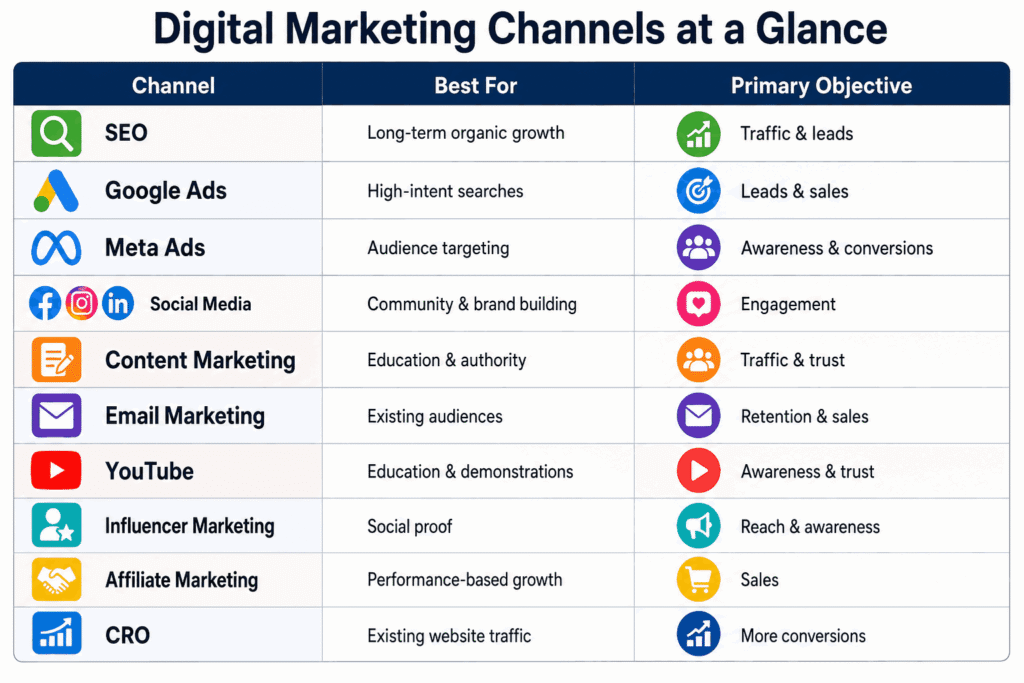
Digital Marketing Channels: Which One Should You Choose?
There is no universal best channel.
Real-Life Digital Marketing Example
Imagine a local dental clinic wants to generate more appointments.
Instead of relying entirely on offline advertising, the clinic creates an integrated digital strategy. This practical example makes the Digital Marketing Meaning easier to understand because different online channels work together toward one clear business goal: generating qualified appointments.
SEO
The clinic creates pages targeting searches such as:
- Dentist in Pune
- Dental clinic near me
- Teeth cleaning Pune
- Root canal treatment Pune
By optimizing these pages for relevant search intent, the clinic can improve its chances of attracting people who are actively looking for dental services.
Content Marketing
It publishes educational articles explaining:
- How root canal treatment works
- How often teeth should be cleaned
- What causes tooth sensitivity
- When to see a dentist
This content helps answer potential patients’ questions, build trust, and establish the clinic as a useful source of information.
Google Ads
The clinic runs paid search campaigns for high-intent terms.
For example, advertisements can target people searching for specific dental treatments or clinics in their local area. This allows the clinic to reach potential patients who may already be ready to make an appointment.
Social Media
Instagram content showcases:
- Educational tips
- Doctor introductions
- Patient-friendly explanations
- Clinic facilities
Social media helps the clinic remain visible to its audience and build familiarity before someone decides to book an appointment.
Conversion Optimization
The website includes:
- Clear appointment CTA
- Phone number
- WhatsApp button
- Doctor information
- Reviews
- Location details
These elements reduce friction and make it easier for interested visitors to take the next step.
Measurement
The clinic tracks:
- Organic traffic
- Paid traffic
- Calls
- WhatsApp enquiries
- Appointment bookings
- Cost per lead
- Cost per appointment
This measurement process is an important part of the Digital Marketing Meaning because digital marketing is not simply about generating visibility. The goal is to understand how online activities contribute to measurable business outcomes.
The important lesson is that digital marketing works best as a system rather than a collection of disconnected activities.
When SEO, content, Google Ads, social media, conversion optimization, and analytics work together, a business can create a more complete customer journey from discovery to conversion.
How to Measure Digital Marketing ROI
ROI is one of the most important concepts for business owners.
Understanding ROI also adds another dimension to the Digital Marketing Meaning, because successful marketing should ultimately contribute to business growth and profitability rather than focusing only on clicks, impressions, or followers.
A simple ROI calculation is:
ROI = (Return from Marketing − Marketing Investment) ÷ Marketing Investment × 100
For example, suppose a company invests ₹1,00,000 in a campaign and generates ₹3,00,000 in attributable revenue.
The calculation is:
ROI = (₹3,00,000 − ₹1,00,000) ÷ ₹1,00,000 × 100
That equals 200% ROI.
This means the business generated ₹2 in return above the original ₹1 marketing investment for every ₹1 invested, based on the simplified calculation above.
However, revenue alone does not always tell the complete story.
Businesses should also consider:
- Gross margin
- Customer acquisition cost
- Customer lifetime value
- Repeat purchases
- Sales cycle
- Lead quality
- Attribution limitations
For example, a campaign might generate a large number of leads, but if those leads are not qualified, the campaign may not produce strong business results.
Similarly, an SEO campaign may take time to generate significant conversions but can continue attracting organic traffic after the initial content and optimization work.
Therefore, the practical Digital Marketing Meaning for business owners is closely connected to measurable performance. Businesses should evaluate not only how many people they reach but also how effectively that reach contributes to leads, customers, revenue, and long-term growth.
Key Takeaway
A successful digital strategy connects visibility → traffic → engagement → leads → conversions → revenue.
When every stage is measured and optimized, businesses can make better marketing decisions and allocate their budgets toward activities that create the greatest potential business value.
How 18 Media Digital Can Help With Digital Marketing

Understanding the Digital Marketing meaning is only the beginning.
The bigger challenge is turning that knowledge into a strategy that generates measurable business results.
At 18 Media Digital, a digital marketing strategy can be built around the specific goals, audience, industry, and growth stage of a business.
A comprehensive strategy may include:
- SEO
- Local SEO
- Google Ads
- Meta Ads
- Social media marketing
- Content marketing
- Website optimization
- Conversion rate optimization
- Analytics
- Lead generation
- Digital strategy
Instead of treating every channel separately, businesses can build an integrated approach where search visibility, content, advertising, social media, and conversion optimization support one another.
Follow 18 Media Digital on Social Media
Want to stay updated with the latest digital marketing tips, SEO strategies, social media trends, advertising insights, and business growth ideas?
Follow 18 Media Digital on our social media channels:
- Instagram: Follow 18 Media Digital on Instagram
- Facebook: Follow 18 Media Digital on Facebook
- LinkedIn: Follow 18 Media Digital on LinkedIn
- Pinterest: Follow 18 Media Digital on Pinterest
- X (Twitter): Follow 18 Media Digital on X
- YouTube: Subscribe to 18 Media Digital on YouTube
Follow 18 Media Digital and stay connected with practical digital marketing insights, industry updates, and strategies designed to help businesses grow online.
Frequently Asked Questions About Digital Marketing
1. What is the meaning of digital marketing?
The Digital Marketing meaning refers to promoting products, services, brands, or businesses through digital channels such as search engines, websites, social media, email, online advertising, and mobile platforms. It helps businesses attract, engage, convert, and retain customers online.
2. What are the main types of digital marketing?
The main types of digital marketing include SEO, Google Ads, social media marketing, content marketing, email marketing, influencer marketing, affiliate marketing, mobile marketing, and conversion rate optimization (CRO). Businesses can select the channels that best match their audience and marketing objectives.
3. Why is digital marketing important for businesses?
Digital marketing helps businesses reach targeted audiences, increase online visibility, generate qualified traffic and leads, build customer relationships, and measure marketing performance. Unlike many traditional methods, digital campaigns can be tracked and optimized using data.
4. How does digital marketing help generate ROI?
Digital marketing can generate ROI by attracting potential customers through channels such as SEO, Google Ads, social media, and content marketing, then converting them through optimized websites and landing pages. Businesses can measure metrics such as cost per lead, conversion rate, customer acquisition cost, revenue, and customer lifetime value to evaluate performance.
5. Which digital marketing channel is best for a business?
There is no single best channel for every business. The right choice depends on factors such as target audience, industry, business goals, budget, customer journey, and competition. A strong digital strategy often combines multiple channels, such as SEO for long-term traffic and Google Ads for high-intent leads.
Leave a Reply