

Introduction
The internet has changed the way people search for information, communicate with businesses, compare products, and make purchasing decisions. Because of this, businesses need to understand how to reach customers through digital platforms.
If you are new to digital marketing, you may have questions such as What is digital marketing?, How does it work? Which skills should I learn? Which tools should I use? And how can I start a career in this field?
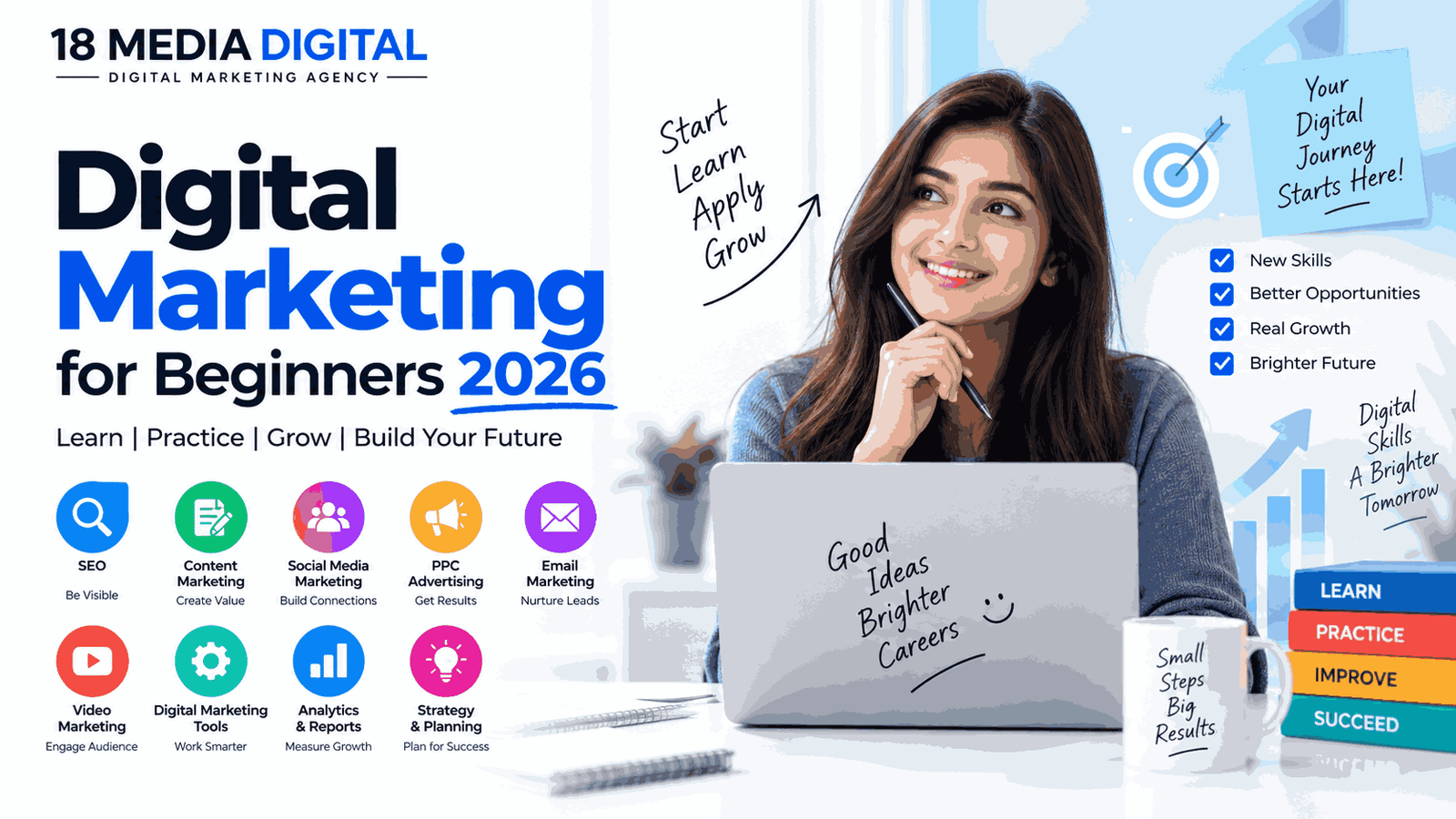
This Digital Marketing for Beginners 2026 guide answers these questions in simple language. It explains the basic concepts, important channels, useful tools, practical examples, and steps you can follow to start learning digital marketing.
Whether you are a student, beginner, freelancer, business owner, or someone planning a career in marketing, this guide can help you build a strong foundation.
What Is Digital Marketing?
Digital marketing is the process of promoting a business, product, service, or brand using digital channels and online platforms.
These channels can include:
- Search engines
- Websites
- Social media
- Online advertising
- Video platforms
- Mobile applications
- Digital content
For example, when a business appears in Google search results, publishes an Instagram post, runs an online advertisement, sends an email newsletter, or publishes a helpful blog, it is using digital marketing.
In simple words, digital marketing helps businesses connect with potential customers through digital platforms.
Digital Marketing Meaning
The meaning of digital marketing is not limited to online advertising.
It includes all the activities businesses use to attract people, communicate with them, build relationships, generate leads, make sales, and retain customers through digital channels.
A business can use digital marketing to:
- Increase online visibility
- Reach a target audience
- Generate website traffic
- Generate leads
- Increase sales
- Build brand awareness
- Communicate with customers
- Measure marketing performance
For beginners, understanding this bigger picture is important before learning individual marketing channels.
Digital Marketing Definition
A simple digital marketing definition is:
Digital marketing is the use of digital channels, platforms, and technologies to promote products, services, brands, or businesses and connect with a target audience.
It combines marketing principles with digital technologies to help businesses reach people where they spend their time online.
Why Is Digital Marketing Important in 2026?
Digital marketing is important because customers use digital platforms throughout their buying journey.
A customer may search Google for a product, watch videos about it, read reviews, visit a company’s website, compare different options, and then contact or purchase from a business.
This creates opportunities for businesses to connect with potential customers at different stages.
Some important benefits include:
Wider Reach:
Businesses can reach customers beyond their immediate geographical location.
Targeted Marketing:
Digital platforms can help businesses reach specific audiences based on relevant targeting options.
Measurable Performance:
Marketers can track traffic, engagement, leads, conversions, and other performance indicators.
Flexible Budgets:
Businesses can choose marketing activities according to their available resources and objectives.
Customer Interaction:
Digital channels provide opportunities for businesses to communicate directly with their audiences.
How Does Digital Marketing Work?
A simple way to understand digital marketing is through the customer journey.
Awareness → Interest → Consideration → Conversion → Retention
1. Awareness
A potential customer discovers a business through search engines, social media, advertising, videos, or content.
2. Interest
The person becomes interested and starts learning more about the business, product, or service.
3. Consideration
The customer compares different options, checks reviews, visits websites, or looks for additional information.
4. Conversion
The customer takes a desired action, such as making a purchase, submitting a form, calling a business, or booking a service.
5. Retention
After the conversion, the business continues communicating with the customer through content, email, social media, customer service, and other channels.
Types of Digital Marketing
There are several major types of digital marketing. Beginners should understand the purpose of each one.
1. Search Engine Optimization (SEO)
SEO stands for Search Engine Optimization.
It is the process of improving a website and its content to increase its visibility in organic search results.
SEO can involve:
- Keyword research
- On-page SEO
- Technical SEO
- Content optimization
- Internal linking
- Off-page SEO
- Website improvements
For example, a digital marketing agency can publish helpful articles about digital marketing services and optimize them for relevant search queries.
SEO is generally a long-term activity that requires consistency and ongoing optimization.
2. Content Marketing
Content marketing focuses on creating and distributing useful content for a target audience.
Examples include:
- Blog posts
- Articles
- Guides
- Videos
- Infographics
- Case studies
- Ebooks
- Social media content
The purpose of content marketing is to provide useful information, answer questions, build trust, and support the customer journey.
For beginners, content marketing is an important skill because almost every digital channel depends on useful content.
3. Social Media Marketing
Social media marketing uses social platforms to connect with audiences and promote a business.
Businesses can use social media to:
- Build brand awareness
- Share content
- Promote products
- Generate leads
- Communicate with customers
- Increase engagement
- Drive website traffic
Popular platforms include Instagram, Facebook, LinkedIn, YouTube, and other social networks.
The right platform depends on the target audience and business objectives.
4. Pay-Per-Click Advertising
Pay-Per-Click, commonly called PPC, is a form of paid advertising.
Businesses can use paid search and other online advertising platforms to reach potential customers.
PPC can be used for:
- Website traffic
- Lead generation
- Product sales
- Local business promotion
- Brand awareness
Unlike SEO, paid campaigns can provide visibility quickly, but they require proper budget management, targeting, testing, and optimization.
5. Email Marketing
Email marketing involves sending relevant messages to customers and potential customers through email.
Common uses include:
- Newsletters
- Offers
- Product updates
- Educational information
- Lead nurturing
- Customer communication
Email marketing can help businesses maintain relationships with their existing audience and guide prospects toward conversion.
6. Video Marketing
Video marketing uses video content to communicate with an audience.
Examples include:
- Tutorials
- Educational videos
- Product demonstrations
- Short-form videos
- Customer testimonials
- Webinars
- Explainer videos
Video can make complex information easier to understand and can support awareness, engagement, and education.
7. Influencer Marketing
Influencer marketing involves working with creators or individuals who have an established audience.
Businesses may collaborate with relevant influencers to introduce products or services to their audience.
The best partnerships should match the brand, target audience, content style, and campaign objectives.
8. Affiliate Marketing
Affiliate marketing is a performance-based approach where affiliates promote a company’s products or services.
Depending on the program, affiliates can earn a commission when their promotional efforts result in qualifying actions.
This can help businesses reach new audiences through websites, publishers, creators, and other partners.
9. Mobile Marketing
Mobile marketing focuses on reaching users through mobile devices.
Examples include:
- Mobile-friendly websites
- SMS marketing
- Mobile applications
- Push notifications
- Mobile advertising
Since smartphones are an important way people access digital content, businesses should provide a good mobile experience.
Important Digital Marketing Channels
A business can use multiple digital marketing channels depending on its goals.
| Digital Marketing Channel | Main Purpose |
|---|---|
| SEO | Organic search visibility |
| Content Marketing | Education and audience engagement |
| Social Media Marketing | Awareness and engagement |
| PPC | Paid traffic and conversions |
| Email Marketing | Communication and retention |
| Video Marketing | Education and engagement |
| Influencer Marketing | Audience reach |
| Affiliate Marketing | Performance-based promotion |
| Website Marketing | Information and conversions |
| Analytics | Measurement and optimization |
You do not need to use every channel. The right combination depends on your business, audience, industry, budget, and objectives.
Digital Marketing Strategy for Beginners
Learning individual channels is useful, but beginners should also understand how they work together.
A basic digital marketing strategy can follow these steps.
Step 1: Define Your Goal
Start by identifying what you want to achieve.
Your goal could be:
- More website traffic
- More leads
- More sales
- Better brand awareness
- Higher search visibility
- More customer engagement
Step 2: Identify Your Target Audience
Understand your ideal customers.
Ask:
- Who are they?
- What problems do they have?
- What are they searching for?
- Which digital platforms do they use?
- What influences their decisions?
Step 3: Conduct Keyword Research
Keyword research helps you understand what people search for online.
For example:
- Digital marketing agency
- Digital marketing services
- SEO services
- Social media marketing
- PPC services
Step 4: Choose Your Channels
Select the channels that match your audience and objectives.
Step 5: Create Useful Content
Create content that answers questions and solves problems for your target audience.
Step 6: Promote the Content
Use appropriate organic and paid channels to distribute your content.
Step 7: Measure Results
Track important metrics to understand campaign performance.
Step 8: Optimize
Use the data you collect to improve your strategy.
Essential Digital Marketing Skills for Beginners
If you want to build a career in digital marketing, developing practical skills is important.
SEO Skills
Learn:
- Keyword research
- Search intent
- On-page SEO
- Technical SEO basics
- Content optimization
- Link building fundamentals
Content Skills
Learn how to create:
- Blog articles
- Website content
- Social media posts
- Video ideas
- Educational content
Social Media Skills
Understand:
- Content planning
- Platform selection
- Audience engagement
- Social media analytics
- Content strategy
PPC Skills
Learn the basics of:
- Keywords
- Ad copy
- Audience targeting
- Campaign structure
- Budgets
- Performance analysis
Analytics Skills
Learn how to understand:
- Traffic
- Engagement
- Leads
- Conversions
- Campaign performance
Communication Skills
Digital marketers also need strong communication skills because they often work with clients, teams, designers, writers, developers, and customers.
Digital Marketing Tools for Beginners
Tools help digital marketers research, create, manage, and measure their work.
Common tool categories include:
SEO Tools
Used for:
- Keyword research
- Website audits
- Competitor research
- Rank tracking
- Backlink analysis
Analytics Tools
Used to understand:
- Website visitors
- Traffic sources
- User behavior
- Conversions
- Marketing performance
Content Creation Tools
Used for:
- Graphic design
- Video editing
- Content planning
- Content creation
Social Media Tools
Used for:
- Scheduling posts
- Managing accounts
- Monitoring engagement
- Measuring performance
Email Marketing Tools
Used for:
- Email campaigns
- Subscriber management
- Automation
- Performance tracking
Beginners should focus on understanding how tools work rather than trying to learn every available platform.
Digital Marketing Examples
Let’s consider a simple example of a local business.
Imagine a digital marketing agency wants to attract new clients.
It could:
- Create a professional website.
- Optimize important pages for SEO.
- Publish educational blog articles.
- Share content on LinkedIn and other social platforms.
- Create informative videos.
- Run paid advertising campaigns.
- Collect leads through website forms.
- Follow up with potential customers through email.
- Track website and campaign performance.
- Improve its strategy using data.
This example shows how multiple digital marketing activities can work together instead of operating separately.
How to Learn Digital Marketing for Beginners
If you are starting from zero, follow a step-by-step learning process.
Start With Digital Marketing Basics
First understand:
- What digital marketing is
- Digital marketing meaning
- Digital marketing channels
- Customer journey
- Marketing funnel
- Types of digital marketing
Learn One Channel at a Time
Start with SEO or content marketing and understand the fundamentals before moving to another area.
Practice What You Learn
Create a simple website, blog, social media page, or practice project.
Learn the Tools
Use relevant tools while working on practical projects.
Analyze Results
Learn to understand what your data is telling you.
Build a Portfolio
Keep examples of your work, projects, campaigns, content, or SEO improvements.
Keep Learning
Digital marketing changes continuously. New technologies, platforms, search behaviors, and marketing practices can affect how businesses reach customers.
Common Mistakes Digital Marketing Beginners Should Avoid
1. Trying to Learn Everything at Once
Digital marketing has many areas. Trying to master everything immediately can become confusing.
2. Focusing Only on Traffic
Website traffic is useful, but the ultimate goal may be leads, sales, engagement, or another business outcome.
3. Ignoring Search Intent
A keyword can have high search volume but still not match what your audience or business needs.
4. Creating Content Without a Purpose
Every piece of content should have a clear audience and objective.
5. Ignoring Analytics
Without measuring results, it is difficult to know which activities are performing well.
6. Expecting Instant SEO Results
SEO generally requires consistent effort, quality content, technical improvements, and time.
7. Keyword Stuffing
Do not repeatedly force keywords into content. Use keywords naturally and focus on providing a good experience for readers.
Digital Marketing Career Opportunities
Digital marketing offers several career paths.
Depending on your interests, you can explore roles such as:
- SEO Executive
- SEO Specialist
- Content Writer
- Content Marketing Specialist
- Social Media Executive
- Social Media Manager
- PPC Executive
- Performance Marketing Specialist
- Email Marketing Specialist
- Digital Marketing Executive
- Digital Marketing Manager
- Digital Marketing Consultant
You can also work as a freelancer or provide digital marketing services to businesses.
The best approach is to develop a strong foundation first and then specialize in an area that matches your interests and strengths.
Digital Marketing Trends in 2026
The digital marketing landscape continues to evolve.
Some areas beginners should understand include:
Artificial Intelligence
AI is increasingly being used for research, content workflows, data analysis, personalization, automation, and marketing operations.
Changing Search Behavior
People discover information through search engines, social media, video platforms, and increasingly AI-powered experiences.
Short-Form Video
Short-form video continues to be an important format for awareness, education, and audience engagement.
Personalization
Businesses are working to provide more relevant experiences based on customer needs and behavior.
Marketing Automation
Automation can help marketers manage repetitive activities such as email sequences, reporting, lead nurturing, and campaign workflows.
First-Party Data
Businesses are placing greater importance on responsibly collecting and using information from their own customer relationships and digital properties.
For beginners, the most important lesson is to understand the fundamentals rather than chasing every new trend.
Digital Marketing vs Traditional Marketing
Traditional marketing uses channels such as:
- Television
- Radio
- Newspapers
- Magazines
- Billboards
- Direct mail
Digital marketing uses:
- Search engines
- Websites
- Social media
- Online advertising
- Video platforms
Digital marketing provides businesses with digital channels for audience interaction, targeting, measurement, and optimization.
However, traditional marketing can still be useful for certain businesses and audiences. Many companies use a combination of traditional and digital marketing.
How to Start Digital Marketing as a Beginner
If you want to start your digital marketing journey in 2026, follow this simple roadmap:
Step 1: Learn digital marketing fundamentals.
Step 2: Understand the major marketing channels.
Step 3: Choose one area to focus on.
Step 4: Learn the relevant tools.
Step 5: Create a practical project.
Step 6: Analyze your results.
Step 7: Build a portfolio.
Step 8: Continue learning and improving.
Remember, digital marketing is a practical field. Reading about marketing is useful, but applying what you learn is equally important.
Conclusion
Starting digital marketing can seem difficult because there are many channels, tools, strategies, and concepts to understand. However, you do not need to learn everything at once.
Start with the basics, understand how each channel works, practice with real projects, measure your results, and gradually develop specialized skills.
This Digital Marketing for Beginners 2026 guide provides a foundation for understanding SEO, content marketing, social media, PPC, email marketing, video marketing, analytics, tools, strategies, and career opportunities.
If you are planning to build your online presence or need professional help with digital marketing, 18 Media Digital can help you develop a practical strategy focused on your business goals.
Learn the basics. Build your skills. Practice consistently. Measure your results. Grow your digital presence.
Follow 18 Media Digital on Social Media
18 Media Digital is a Digital Marketing Agency helping businesses strengthen their online presence through digital marketing strategies, SEO, content marketing, social media marketing, paid advertising, and other digital solutions.
Want to stay updated with the latest digital marketing tips, SEO strategies, social media trends, advertising insights, and business growth ideas?
Follow 18 Media Digital on our social media channels:
Follow 18 Media Digital and stay connect
Website: 18 Media Digital
Contact: 9854991818
Location: 1st Floor, D17, Airport Rd, near Belsare Hospital, Kasturba D, Kasturba Housing Society, Vishrantwadi, Pune, Maharashtra 411015
Frequently Asked Questions About Digital Marketing for Beginners
What is digital marketing for beginners?
Digital Marketing for Beginners 2026 means learning the basic concepts, channels, strategies, tools, and skills needed to understand how businesses market themselves online. This Digital Marketing for Beginners approach helps new learners understand the subject step by step.
Is digital marketing easy to learn?
The fundamentals can be learned step by step, but becoming highly skilled requires practice, experimentation, analysis, and continuous learning. Digital Marketing for Beginners becomes easier when you focus on one skill at a time.
What should I learn first in digital marketing?
Start with the fundamentals, including digital marketing meaning, types of digital marketing, customer journey, marketing funnel, SEO, content marketing, social media, PPC, and analytics. A structured Digital Marketing for Beginners learning path can make these concepts easier to understand.
Can students learn digital marketing?
Yes. Students can learn digital marketing through online resources, practical projects, internships, courses, and hands-on experience. Digital Marketing for Beginners is suitable for students who want to develop practical marketing skills.
Is digital marketing a good career?
Digital marketing offers multiple career paths across SEO, content, social media, paid advertising, analytics, email marketing, and strategy.
Do I need coding skills for digital marketing?
Basic digital marketing roles do not always require advanced coding skills. However, understanding basic website and technical concepts can be useful, especially when working with SEO and websites.
Which digital marketing skill should beginners learn first?
SEO, content marketing, social media marketing, analytics, and paid advertising are useful areas to explore. Choose based on your interests and career goals.
How can I get practical digital marketing experience?
You can create a personal website, start a blog, manage a social media page, work on practice campaigns, complete projects, or gain experience through internships and freelance work. This practical experience is an important part of learning Digital Marketing for Beginners.
Leave a Reply