

If you’ve ever wondered how brands seem to know exactly what you’re looking for online, or how a small local business competes with big names on Google — the answer is digital marketing. It’s the engine behind almost every online interaction between businesses and customers today, from the ads you scroll past on Instagram to the emails sitting in your inbox.
This guide breaks down what digital marketing actually means, the channels that make it up, and the trends shaping the industry in 2026 — so you have a solid foundation, whether you’re exploring it as a career or trying to grow a business.
What Is Digital Marketing?
Digital marketing is the practice of promoting products, services, or brands using digital channels — search engines, social media, email, websites, and mobile apps — instead of traditional offline channels like print, TV, or radio.
At its core, digital marketing is about reaching the right person with the right message at the right time, using data and digital tools to make that connection measurable. Unlike a newspaper ad, whose impact is hard to track, a digital marketing campaign can tell you exactly how many people saw it, clicked it, and bought something because of it.
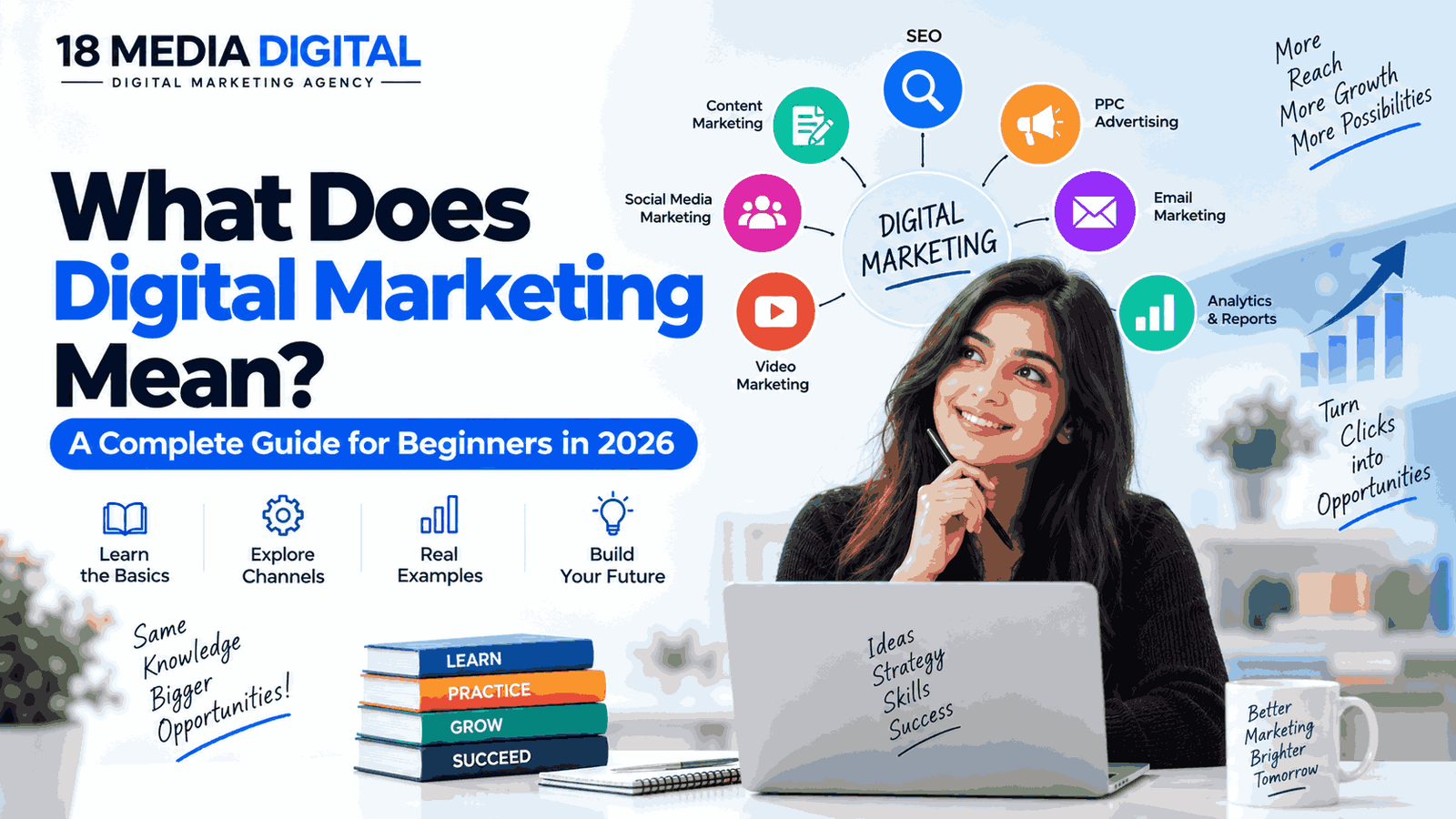
Digital marketing covers a wide range of activities, including:
- Ranking a website higher on Google (SEO)
- Running paid ads on Google or social media
- Publishing blogs, videos, and social content
- Sending targeted email campaigns
- Building a brand’s reputation and presence online.
Why Digital Marketing Matters in 2026
Global digital advertising spend is projected to cross the $1 trillion mark in 2026 — a sign of just how central digital channels have become to business growth. But scale isn’t the only story. The way people search and discover brands is changing fast. A large share of Google searches now end without a single click, as AI-generated answers deliver information directly on the results page, and click-through rates fall sharply whenever one of these AI answers appears.
For businesses, this means visibility isn’t just about ranking on page one anymore — it’s about becoming a source AI systems trust enough to reference. That shift makes digital marketing more important, not less. Businesses that understand both the fundamentals (SEO, content, paid ads) and what’s emerging (AI-driven search, automation) are the ones set up to grow through 2026 and beyond.
Types of Digital Marketing: Core Channels Explained
1. Search Engine Optimization (SEO)
SEO is the process of improving a website so it ranks higher on search engines like Google for relevant keywords, without paying for ads. It includes on-page work (content, keywords, title tags, meta descriptions), technical work (site speed, mobile-friendliness, schema markup), and off-page work (backlinks, brand mentions). Good SEO compounds over time, making it one of the most cost-effective long-term channels.
2. Content Marketing
Content marketing means creating valuable content — blog posts, videos, guides, infographics — to attract and engage an audience rather than directly pitching a product. It builds trust and authority, and it’s the foundation that makes SEO, social media, and email marketing work better.
3. Social Media Marketing
This involves promoting a brand and engaging audiences on platforms like Instagram, Facebook, LinkedIn, and YouTube. It spans organic posting, community engagement, and paid social advertising — often where a brand’s personality comes through most clearly.
4. Pay-Per-Click (PPC) Advertising
PPC lets businesses place ads on search engines or social platforms and pay only when someone clicks. Google Ads and Meta Ads are the two biggest platforms. PPC delivers fast, measurable results, which makes it a useful complement to slower-building channels like SEO.
5. Email Marketing
Despite being one of the oldest digital channels, email marketing remains one of the highest-ROI options available. It’s used for nurturing leads, promoting offers, and keeping customers engaged well after their first purchase.
6. Affiliate Marketing
In affiliate marketing, businesses pay commissions to partners who promote their products and drive sales through unique tracking links. It’s performance-based, so businesses only pay for actual results.
7. Influencer Marketing
This involves partnering with individuals who have an engaged following to promote a product or service, tapping into the trust they’ve already built with their audience. It’s especially effective on Instagram and YouTube.
8. Marketing Automation
Marketing automation uses software to handle repetitive tasks — like sending follow-up emails or scoring leads — so teams can focus on strategy instead of manual execution. This is increasingly powered by AI in 2026.
Digital Marketing Trends to Watch in 2026
AI has moved from tool to strategy. AI is no longer just an automation add-on — it now sits at the center of how many marketing teams plan and run campaigns, from generating content variations to analyzing customer behavior in real time. This increasingly includes “agentic AI” — systems capable of carrying out multi-step marketing tasks with minimal manual input. The marketer’s role is shifting from executing tasks to directing these tools.
Search is moving into AI engines. A significant share of Google searches now end without a click, as AI Overviews answer queries directly on the results page. This is pushing SEO strategy toward earning a mention inside AI-generated answers, not just a top-10 ranking.
Personalization is non-negotiable. Consumers are markedly more likely to buy from brands that personalize content and offers, which makes broad, one-size-fits-all campaigns less effective than ever.
Privacy-first data strategy. With third-party cookies fading out, businesses are leaning harder into first-party data — information collected directly from customers — to power personalization responsibly.
Video and CTV keep growing. Short-form video remains dominant, but connected TV (streaming) and shoppable video are becoming real performance channels, not just brand-awareness tools.
Digital Marketing vs. Traditional Marketing
| Traditional Marketing | Digital Marketing |
|---|---|
| One-way communication | Two-way, interactive |
| Hard to measure ROI | Precisely trackable |
| Broad targeting | Highly specific targeting |
| High cost for wide reach (TV, print) | Flexible budgets, even for small businesses |
| Slow to adjust mid-campaign | Can be optimized in real time |
Neither fully replaces the other, and many established brands still blend both. But digital marketing’s ability to target, measure, and adjust in real time is why it now commands the majority of most marketing budgets.
How to Get Started in Digital Marketing as a Beginner
- Learn the fundamentals first. Understand core concepts — SEO, content, paid ads, analytics — before specializing in one.
- Pick one channel and go deep. Trying to master everything at once leads to shallow knowledge everywhere. Choose SEO, social media, or paid ads and build real skill there first.
- Practice with free tools. Google Analytics, Google Search Console, Meta Business Suite, and Canva are free and industry-standard — hands-on practice beats theory.
- Build a portfolio, even without clients. Start a blog, run a sample social page, or offer to help a local business at low cost to create real case studies.
- Follow credible sources, not hype. This field changes constantly — follow official platform blogs (Google, Meta) and established industry publications rather than chasing every trend on social media.
Conclusion
Understanding What Does Digital Marketing Mean is the first step toward building strong online marketing knowledge. What Does Digital Marketing Mean goes beyond advertising and includes SEO, content, social media, paid ads, email marketing, AI, and data-driven strategies. For beginners, learning What Does Digital Marketing Mean does not require mastering every channel at once. Start by understanding the overall digital marketing landscape, then choose one area to develop practical skills in. With consistent learning, hands-on practice, and performance analysis, beginners can gradually build valuable digital marketing knowledge and apply it effectively to businesses, brands, and career opportunities
Follow 18 Media Digital on Social Media
18 Media Digital is a Digital Marketing Agency helping businesses strengthen their online presence through digital marketing strategies, SEO, content marketing, social media marketing, paid advertising, and other digital solutions.
Want to stay updated with the latest digital marketing tips, SEO strategies, social media trends, advertising insights, and business growth ideas?
Follow 18 Media Digital on our social media channels:
Follow 18 Media Digital and stay connect
Website: 18 Media Digital
Contact: 9854991818
Location: 1st Floor, D17, Airport Rd, near Belsare Hospital, Kasturba D, Kasturba Housing Society, Vishrantwadi, Pune, Maharashtra 411015
Frequently Asked Questions
Is digital marketing a good career in 2026?
Yes. What Does Digital Marketing Mean is increasingly important as AI reshapes search, advertising, content, and customer experiences. Businesses need professionals who understand marketing fundamentals as well as modern AI-driven tools, making these combined skills valuable in the digital marketing industry.
Do I need a degree to learn digital marketing?
No. Understanding What Does Digital Marketing Mean does not require a formal degree. You can develop digital marketing skills through online courses, certifications, practical projects, and hands-on experience with platforms and tools.
What’s the difference between digital marketing and SEO?
To understand What Does Digital Marketing Mean, it is important to know that SEO is one channel within digital marketing. Digital marketing is the broader field covering SEO, social media, email marketing, paid advertising, content marketing, and other online activities.
How long does it take to learn digital marketing basics?
Learning What Does Digital Marketing Mean and the fundamentals of one digital marketing channel can take around 4–8 weeks with consistent study. Building stronger practical proficiency generally requires several months of hands-on experience, testing, and continuous learning.
What tools do digital marketers use?
Once you understand What Does Digital Marketing Mean, you can explore tools used for different marketing activities. Common tools include Google Analytics and Search Console for data and SEO, SEMrush or Ahrefs for keyword research, Meta Business Suite for social media and advertising, Mailchimp for email marketing, and Canva for design.
Leave a Reply