
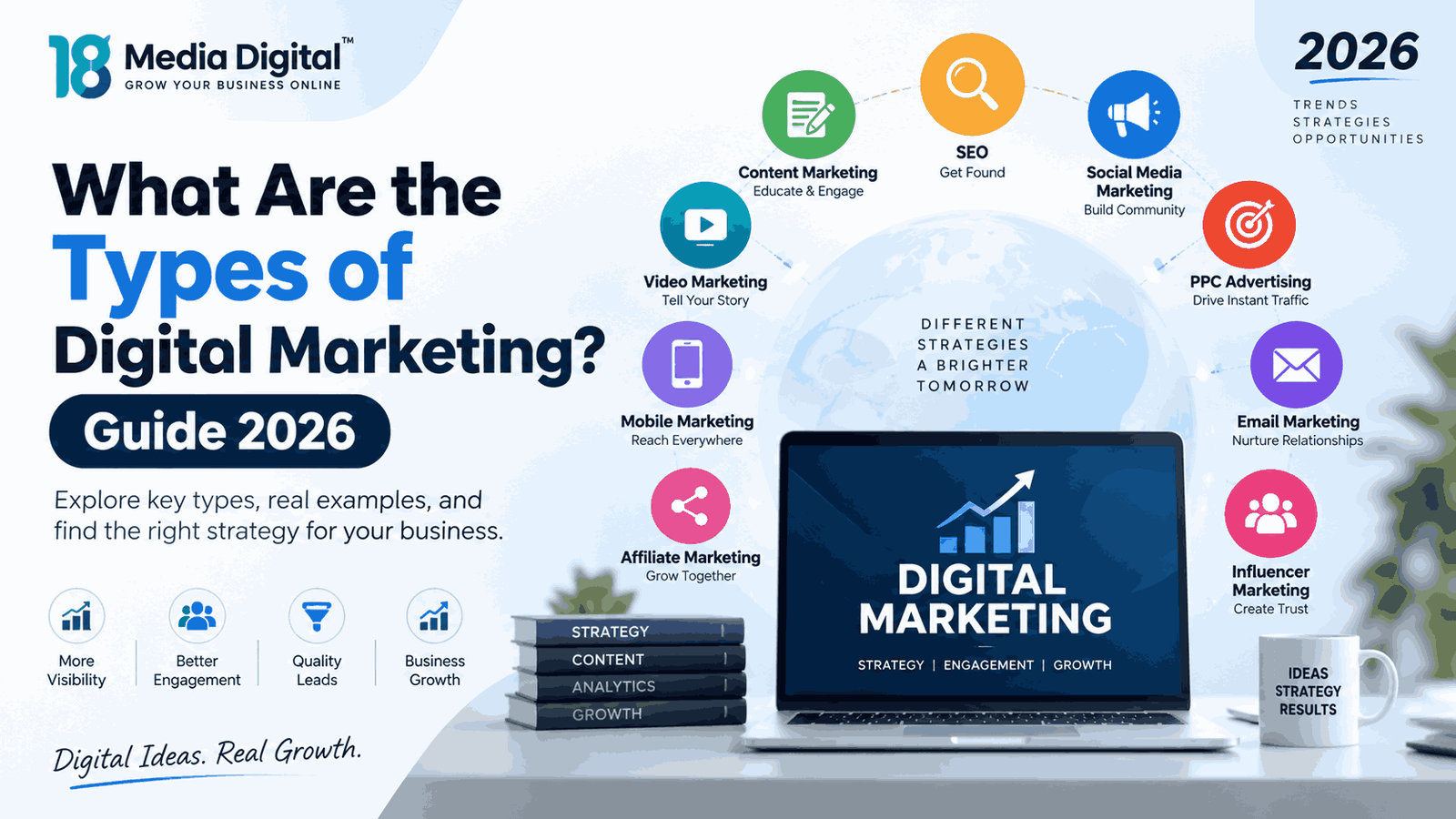

Most lists of digital marketing types simply name channels such as SEO, social media, email, and PPC. However, understanding the types of digital marketing is more useful when you know how each type fits into a broader marketing strategy, what goal it supports, how quickly it can produce results, and what kind of investment it requires.
Different businesses have different goals. A startup may want to build awareness with limited funds, while an established company may focus on generating immediate leads or retaining existing customers. This is why there is no single “best” type of digital marketing for every business.
The Two Big Ways to Classify Digital Marketing Type
Digital marketing types can be understood through two useful frameworks: Paid, Owned, and Earned Media and Inbound vs. Outbound Marketing.
Paid, Owned, and Earned Media
Paid media refers to marketing exposure that a business pays for directly. Examples include PPC advertising, paid social media campaigns, and sponsored influencer promotions. Paid media can provide faster visibility because businesses can actively purchase advertising opportunities and target specific audiences.
Owned media includes digital assets that a business controls. Examples include:
- Business websites
- Blogs
- Email lists
- Social media profiles
- Landing pages
- Branded content
Owned media gives businesses greater control over their messaging and customer experience.
Earned media refers to attention a business receives without directly paying for that specific exposure. Examples include:
- Organic social media shares
- Customer recommendations
- Online mentions
- Press coverage
- Word-of-mouth referrals
- Organic backlinks
In practice, businesses often combine all three. For example, a company can publish useful content on its website, promote that content through paid advertising, and then receive organic shares or backlinks when people find it valuable.
Inbound vs. Outbound Marketing
Another way to understand the types of digital marketing is to divide them into inbound and outbound approaches.
Inbound marketing focuses on attracting people who are already interested in a topic, product, service, or solution. SEO, blogging, educational content, and some forms of social media marketing can support an inbound strategy.
For example, someone searches Google for “best digital marketing agency in Pune.” A relevant website that appears in the search results can attract that person without directly contacting them first.
Outbound marketing involves proactively reaching potential customers. PPC advertising, paid social campaigns, sponsored promotions, and certain forms of email outreach can be considered outbound approaches.
Inbound marketing can help build long-term visibility, while outbound marketing can provide faster opportunities to reach targeted audiences. Many successful strategies combine both.
Quick Reference: Major Types at a Glance
| Type | Media Category | Approach |
|---|---|---|
| SEO | Owned + Earned | Inbound |
| Content Marketing | Owned | Inbound |
| Social Media Marketing | Owned + Earned | Mostly Inbound |
| PPC / Paid Search | Paid | Outbound |
| Paid Social Ads | Paid | Outbound |
| Email Marketing | Owned | Mostly Inbound |
| Influencer Marketing | Paid + Earned | Outbound |
| Affiliate Marketing | Paid + Earned | Outbound |
This table provides a simple overview, but the boundaries are not always absolute. A single channel can serve different purposes depending on how a business uses it.
For example, social media can be used organically to build an audience or through paid advertising to reach a specific group. Email can nurture existing subscribers, while promotional emails can also encourage immediate purchases.
Choosing the Right Type for Your Goal
The best digital marketing channel depends largely on what you want to achieve.
Building Awareness
If your primary goal is increasing brand awareness, organic social media and content marketing can help introduce your business to a wider audience. Useful educational, entertaining, or informative content can attract attention and encourage people to learn more about your brand.
Nurturing Consideration
When people know about your business but are not ready to purchase, content marketing and email marketing can help keep them engaged.
For example, a business could provide:
- Educational blog posts
- Product guides
- Case studies
- Email newsletters
- Helpful videos
- Comparison content
These resources can help potential customers understand their options before making a decision.
Driving Conversions
Businesses looking for immediate traffic, leads, or sales may use PPC and retargeting advertising. These methods can help reach people who are actively searching for a solution or have previously interacted with the business.
For example, someone who visits a service page but does not submit an enquiry may later see a relevant retargeting advertisement.
Retaining Customers
Marketing does not end after a customer makes a purchase. Email marketing and loyalty-focused social engagement can help businesses maintain relationships with existing customers.
Businesses can use these channels for:
- Product updates
- Helpful information
- Special offers
- Customer education
- Loyalty campaigns
- Repeat-purchase reminders
The objective is to turn a one-time transaction into a longer-term customer relationship.
Choosing the Right Type for Your Budget
Budget is another important factor when selecting digital marketing types.
Zero Ad Budget
Businesses with no advertising budget can begin with SEO, content marketing, and organic social media.
These approaches may require significant time and consistent effort, but they do not require direct spending on every visitor or impression.
Small Budget
With a smaller budget, businesses can combine existing organic content with modest PPC or paid social campaigns.
For example, instead of promoting everything, a business could identify its best-performing content or most valuable service and allocate a limited advertising budget toward it.
Larger Budget
Businesses with larger marketing budgets can build multi-channel campaigns combining SEO, paid search, paid social, content, email, and retargeting.
A multi-channel approach allows businesses to reach customers at different stages of the buying journey while using data to evaluate campaign performance.
Pros and Cons: Speed, Cost, and Longevity
Different digital marketing types produce results at different speeds and require different levels of ongoing investment.
| Type | Speed to Results | Ongoing Cost | Longevity |
|---|---|---|---|
| SEO | Slow | Low | High — can compound over time |
| PPC | Fast | Ongoing | Low — traffic generally decreases when spending stops |
| Social Media (Organic) | Medium | Low | Medium |
| Email Marketing | Fast for an existing list | Low | High |
| Influencer Marketing | Medium | Medium–High | Low–Medium |
SEO
SEO can take time because businesses need to create useful content, improve website quality, build authority, and earn visibility in search results. However, successful SEO can provide lasting organic traffic without paying for every click.
PPC
PPC can generate traffic quickly, making it useful when a business needs immediate visibility. The limitation is that advertising requires ongoing spending. When campaigns stop, the paid traffic generated by those campaigns generally stops as well.
Organic Social Media
Organic social media can help businesses build communities and relationships over time. However, results can be unpredictable, and maintaining consistent engagement requires regular content creation.
Email Marketing
Email marketing can be highly effective when a business already has a relevant, permission-based audience. It allows businesses to communicate directly with subscribers without paying for every individual message impression.
Influencer Marketing
Influencer marketing can help businesses reach established audiences through trusted creators. However, costs and results can vary significantly depending on the creator, audience, campaign quality, and level of audience engagement.
How the Different Types Work Together
The most effective digital marketing strategy does not necessarily depend on choosing only one channel.
A business might use:
SEO → Content → Social Media → PPC → Retargeting → Email → Conversion
For example, a user could discover a business through Google search. They may read a blog post, follow the company’s social media account, visit a product page, and leave without purchasing. Later, a retargeting advertisement may bring them back to the website. After joining an email list, they may receive useful information and eventually become a customer.
This demonstrates why understanding the types of digital marketing as a connected system is more useful than simply memorizing a list of channels.
The right combination depends on the business’s goals, audience, budget, industry, customer journey, and available resources.
Conclusion
The types of digital marketing are not just an isolated list of channels; they are practical tools that businesses can use to achieve different marketing goals. The Types of Digital Marketing Guide 2026 helps marketers understand how each channel works and where it can create the most value. From SEO and content marketing to social media, PPC, email marketing, and influencer marketing, every channel has a different purpose, cost, and timeline.
Understanding the Types of Digital Marketing Guide 2026 also becomes easier when you use the two important frameworks: paid, owned, and earned media, along with inbound and outbound marketing. These frameworks help businesses select channels based on their audience, objectives, budget, and resources.
The Types of Digital Marketing Guide 2026 can help beginners avoid choosing channels simply because they are popular. Instead, businesses can focus on channels that match their customer journey and business goals. The Types of Digital Marketing Guide 2026 also shows why combining multiple channels can create stronger results than depending on one method alone.
By understanding the Types of Digital Marketing Guide 2026, businesses can build a more focused, flexible, and effective digital marketing strategy.
Follow 18 Media Digital on Social Media
keting strategies, SEO, content marketing, social media marketing, paid advertising, and other digital solutions.
Want to stay updated with the latest digital marketing tips, SEO strategies, social media trends, advertising insights, and business growth ideas?
Follow 18 Media Digital on our social media channels:
Follow 18 Media Digital and stay connect
Website: 18 Media Digital
Contact: 9854991818
Location: 1st Floor, D17, Airport Rd, near Belsare Hospital, Kasturba D, Kasturba Housing Society, Vishrantwadi, Pune, Maharashtra 411015
Frequently Asked Questions
How many types of digital marketing are there?
There is no single fixed number, but most guides identify around 7–9 core types, including SEO, content marketing, social media marketing, PPC, email marketing, influencer marketing, affiliate marketing, and marketing automation. Understanding Types of Digital Marketing? Guide 2026 helps beginners see how these channels serve different marketing goals.
Which type of digital marketing gives the fastest results?
PPC advertising can provide some of the fastest results because campaigns can begin generating traffic and leads soon after launch. In Types of Digital Marketing? Guide 2026, PPC is considered particularly useful for businesses looking for immediate visibility, while SEO and content marketing generally require more time to build organic results.
Can a business use just one type of digital marketing?
Yes. A business can start with one channel, especially when resources are limited. However, Types of Digital Marketing? Guide 2026 shows that combining two or more relevant channels can help businesses reach customers at different stages of the buying journey.
Is paid media always better than earned or owned media?
No. Paid media can provide faster visibility, but results generally depend on continued spending. Owned and earned media can build long-term value and organic visibility. The Types of Digital Marketing? Guide 2026 approach is to select channels based on the business’s goals, audience, budget, and expected results.
Which types should a beginner learn first?
For beginners, SEO, content marketing, social media marketing, and email marketing are useful starting points because they introduce important concepts such as audience research, content creation, engagement, and measurement. Types of Digital Marketing? Guide 2026 can help beginners understand how these channels work individually and together.
Leave a Reply