

If you want to understand how businesses actually grow in today’s hyper-connected world, you need to know exactly what is digital marketing and its benefits. The days of relying solely on expensive billboards, brief radio slots, and untargeted newspaper ads are rapidly fading. Today, consumer attention lives entirely online. Whether you are a fresh graduate entering the competitive marketing industry or an established brand trying to reach new demographics, mastering these digital channels is no longer just optional—it is the absolute foundation of modern business survival.
To stay ahead of the curve, every entrepreneur and professional must constantly ask themselves what is digital marketing and its benefits for their specific niche. By shifting your focus from traditional outbound methods to data-driven online platforms, you connect with your ideal customers exactly when they are actively searching for your solutions.
When you fully comprehend what is digital marketing and its benefits, you unlock the ability to scale your reach globally while maintaining precise control over your daily advertising budget. In this comprehensive guide, we will break down the core components of online advertising. We will explore exactly what is digital marketing and its benefits, help you learn the essential basics for 2026, and show you how to build a high-converting digital strategy from scratch.
What Is Digital Marketing?
At its core, digital marketing encompasses all marketing efforts that use an electronic device or the internet. Businesses leverage digital channels such as search engines, social media, email, and other websites to connect with current and prospective customers.
Unlike traditional marketing, which often broadcasts a message to a broad, undefined audience, digital marketing allows you to zero in on the exact people who are most likely to buy your product or service. It is data-driven, highly targeted, and entirely measurable.
The Evolution of Digital Marketing in 2026
In 2026, the landscape has shifted heavily toward automation, AI-driven personalization, and hyper-targeted content. Consumers expect brands to understand their needs before they even search for a product. Understanding what digital marketing is and its benefits means recognizing that it is a two-way conversation between a brand and its audience, rather than a one-way sales pitch.
Key Components of Digital Marketing
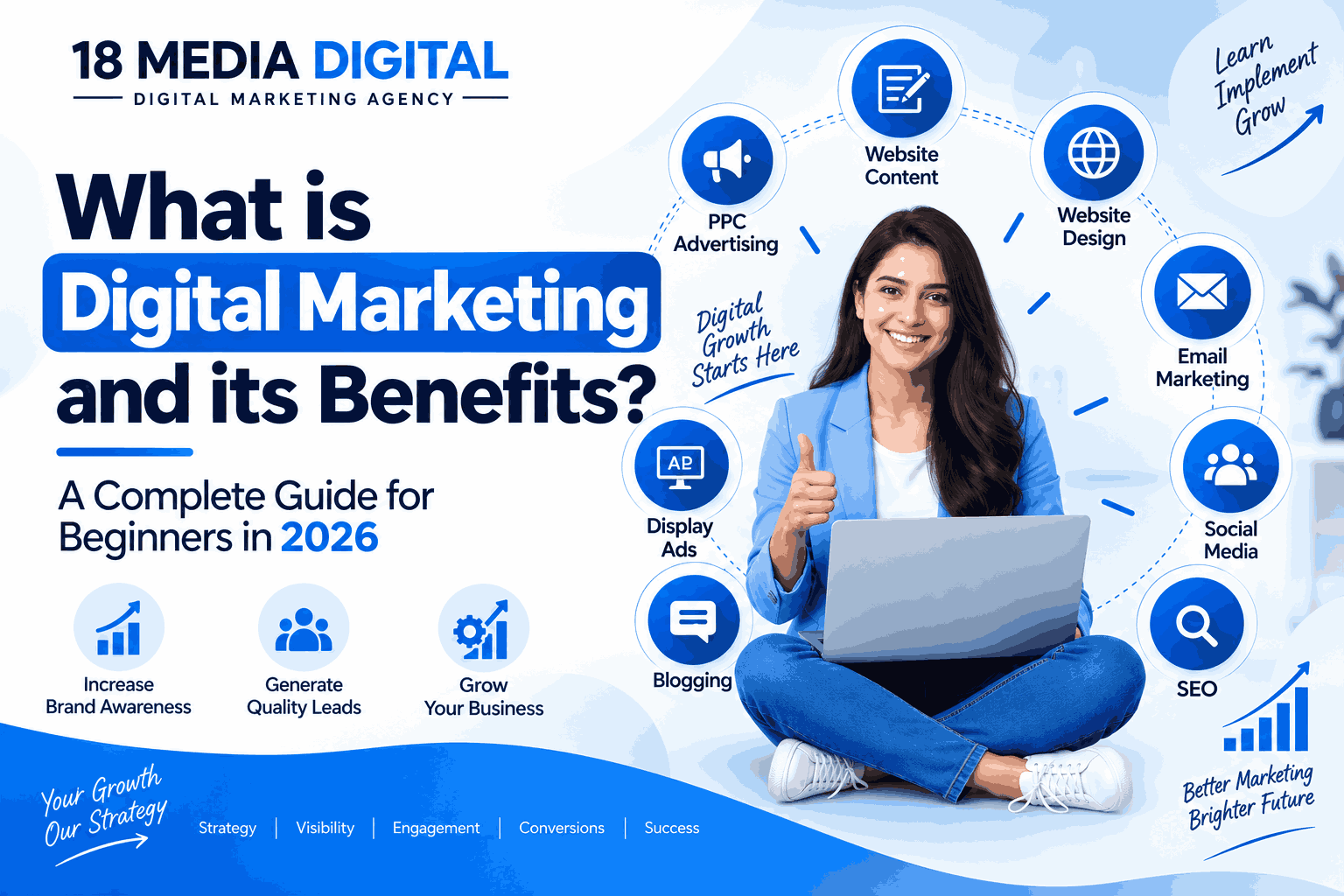
To truly grasp the basics of digital marketing, you need to understand the individual channels that make up a successful strategy. Here are the primary pillars you need to master.
Search Engine Optimization (SEO)
SEO is the art and science of optimizing your website to rank higher in search engine results pages (SERPs) like Google. By increasing your visibility, you drive more organic (free) traffic to your site.
- On-Page SEO: Focusing on content quality, keyword density, and HTML tags.
- Off-Page SEO: Building authority through backlinks from other reputable websites.
- Technical SEO: Ensuring your site is fast, mobile-friendly, and easy for search engines to crawl.
Content Marketing
Content is the fuel that powers every other digital marketing channel. This strategy focuses on creating and distributing valuable, relevant, and consistent content to attract and retain a clearly defined audience.
- Blog Posts: Articles like this one that educate readers and rank on search engines.
- E-books and Whitepapers: Long-form content used to capture contact information.
- Video Content: Highly engaging visual media optimized for platforms like YouTube and TikTok.
Social Media Marketing (SMM)
This practice promotes your brand and content on social media channels to increase brand awareness, drive traffic, and generate leads. The dominant platforms in 2026 include LinkedIn, Instagram, TikTok, and X.
- Organic Social: Building a community and sharing free content.
- Paid Social: Running highly targeted ads to specific demographics.
Pay-Per-Click (PPC)
PPC is a method of driving traffic to your website by paying a publisher every time your ad is clicked. Google Ads is the most common type of PPC, allowing you to pay for top slots on Google’s search engine results pages at a price “per click” of the links you place.
Email Marketing
Despite the rise of new platforms, email remains one of the highest-converting digital marketing channels. It is used to communicate directly with your audience, promote content, offer discounts, and direct people toward your website.
What Are the Benefits of Digital Marketing?
Why do companies invest billions of dollars into digital campaigns? When you ask what digital marketing is and its benefits, the answer always comes down to efficiency, reach, and return on investment (ROI).
1. Global (and Hyper-Local) Reach
Traditional marketing is bound by geography. Digital marketing operates without borders. A small local shop can reach an international audience through a viral social media post or a well-optimized blog. Conversely, local SEO allows businesses to dominate their immediate neighborhood.
For instance, imagine a growing business like Vaishnav Masale planning to expand from selling retail spice powders to supplying whole spices to local hotels. Instead of relying on local flyers, they can use localized LinkedIn outreach or targeted Google Search ads to appear exactly when a hotel procurement manager searches for “bulk whole spice suppliers near me.”
2. Cost-Effectiveness
Digital marketing provides a significantly lower cost of entry compared to traditional media. Small businesses can compete with massive corporations by utilizing smart, highly targeted campaigns rather than outspending them on television spots.
3. Highly Targeted Audiences
With digital marketing, you don’t have to guess who is seeing your ad. You can target audiences based on:
- Demographics (age, gender, income)
- Location (country, city, zip code)
- Interests (hobbies, preferred brands)
- Behaviors (past purchases, search history)
4. Measurable and Trackable Results
One of the greatest benefits of digital marketing is the ability to see accurate results in real time. If you put an ad in a newspaper, it is nearly impossible to know exactly how many people flipped to that page and paid attention. With digital marketing, you can measure:
- Impressions: How many people saw your ad.
- Clicks: How many people interacted with it.
- Conversions: How many people took the desired action (bought a product, filled out a form).
5. Improved Conversion Rates
Because you are measuring every interaction and targeting specific audiences, your conversion rates will naturally improve. By identifying exactly where a customer drops off in the purchasing funnel, you can optimize your website and messaging to capture lost sales.
Traditional Marketing vs. Digital Marketing
To fully appreciate what digital marketing is and its benefits, it helps to compare it to the old way of doing things.
| Feature | Traditional Marketing | Digital Marketing |
| Audience Reach | Broad, mostly local or regional | Global, but can be hyper-targeted |
| Cost | High (TV, radio, print) | Scalable (SEO is free, PPC fits any budget) |
| Communication | One-way (brand to consumer) | Two-way (interactive, community-driven) |
| Analytics | Delayed and estimated | Real-time, highly accurate data |
| Agility | Hard to change once published | Easy to pause, edit, and optimize instantly |
How to Get Started with Digital Marketing in 2026
If you are ready to put the basics of digital marketing into practice, follow this step-by-step framework to launch your first strategy.
- Define Your Goals: Are you looking to build brand awareness, generate leads, or drive direct sales? Your goals will dictate your entire strategy.
- Identify Your Target Audience: Create detailed buyer personas. Understand their pain points, where they hang out online, and what kind of content they consume.
- Establish a Budget for Each Digital Channel: Decide how much you are willing to spend on PPC, paid social, and content creation. Remember that SEO takes time but offers the best long-term ROI.
- Balance Paid and Free Digital Strategies: A successful 2026 strategy requires both. Use paid ads for immediate visibility while building your organic SEO and social media presence for sustainable growth.
- Create Engaging Content: Start building out your blog, recording videos, or designing graphics that speak directly to your audience’s needs.
- Optimize for Mobile: Over half of all global web traffic comes from mobile devices. If your website is not optimized for smartphones, you will lose customers instantly.
- Measure and Adjust: Use tools like Google Analytics to track your success. Double down on the campaigns that work and kill the ones that drain your budget.
Follow 18 Media Digital on Social Media
keting strategies, SEO, content marketing, social media marketing, paid advertising, and other digital solutions.
Want to stay updated with the latest digital marketing tips, SEO strategies, social media trends, advertising insights, and business growth ideas?
Follow 18 Media Digital on our social media channels:
Follow 18 Media Digital and stay connect
Website: 18 Media Digital
Contact: 9854991818Location: 1st Floor, D17, Airport Rd, near Belsare Hospital, Kasturba D, Kasturba Housing Society, Vishrantwadi, Pune, Maharashtra 411015
Conclusion: Key Takeaways
Understanding what is digital marketing and its benefits is the absolute first step toward building a successful modern business or launching a lucrative marketing career today. When industry professionals ask what is digital marketing and its benefits, they are usually looking for sustainable, long-term ways to grow a brand’s online presence. By leveraging essential channels like Search Engine Optimization (SEO), content marketing, and Pay-Per-Click (PPC) advertising, you can effectively reach highly targeted audiences for a fraction of the cost of traditional advertising methods.
To fully grasp what is digital marketing and its benefits, you must recognize that its true power lies in direct measurability and adaptability. This data-driven approach allows you to test, learn, and optimize your live campaigns in real time to maximize your overall return on investment. For ambitious business owners looking to scale their daily operations, exploring what is digital marketing and its benefits reveals exactly how hyper-targeted reach can transform local product sales into consistent, scalable revenue.
Ultimately, whether you are a fresher optimizing your resume for a competitive marketing role or an entrepreneur expanding a dynamic brand, mastering these core basics in 2026 will give you a decisive competitive edge. By continuously analyzing what is digital marketing and its benefits, you ensure your strategic campaigns stay relevant, cost-effective, and perfectly aligned with ever-changing consumer behaviors.
Frequently Asked Questions (FAQ)
1. What is Digital Marketing and its benefits for small businesses?
When evaluating what is Digital Marketing and its benefits, you’ll find it levels the playing field, allowing small businesses to compete with larger corporations. Its main benefits include cost-effective targeting, global reach, and the ability to track the exact return on investment (ROI) for every dollar spent.
2. How long does it take to experience what is Digital Marketing and its benefits firsthand?
It depends on the channel. Paid advertising (PPC) can generate traffic and leads immediately. Organic strategies like Search Engine Optimization (SEO) and content marketing generally take 3 to 6 months to start showing significant results.
3. To truly grasp what is Digital Marketing and its benefits, what basics should I learn first?
Beginners should start by learning the fundamentals of SEO, understanding how social media algorithms work, and mastering basic content creation. Learning how to read and interpret data via Google Analytics is also crucial.
4. Why is SEO a critical factor in realizing what is Digital Marketing and its benefits?
SEO is critical because organic search is arguably the most valuable traffic on the internet. When you rank highly for a search term, you are connecting with users who have high intent to learn or purchase, providing long-term, sustainable traffic without ongoing ad costs.
.
Leave a Reply