
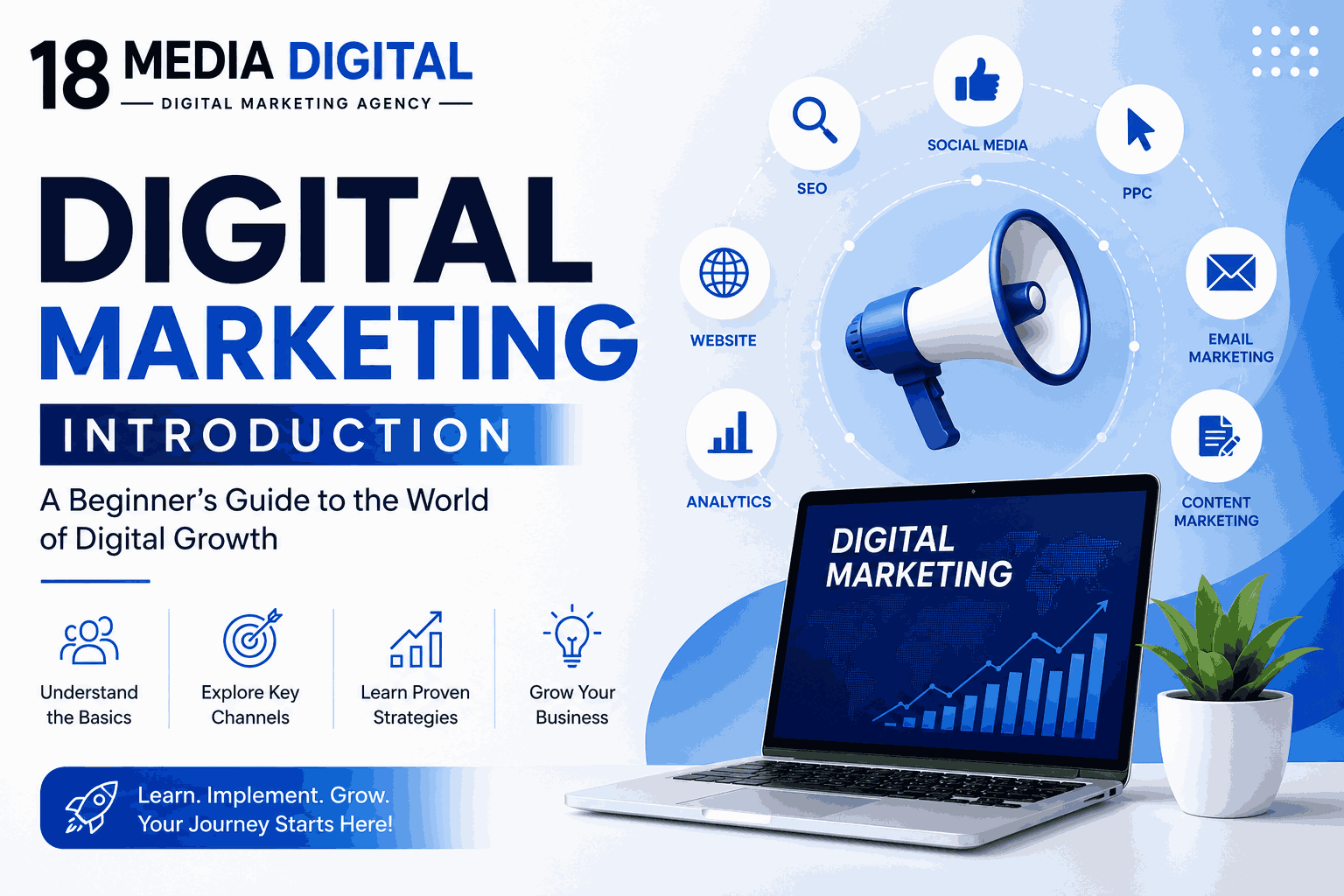

Introduction:
If you’ve ever searched for something on Google, clicked an Instagram ad, or received a discount code by email, you’ve already been on the receiving end of digital marketing. It’s the reason a small shop in your city can show up on your phone at exactly the moment you’re looking for what it sells.
For beginners, though, the term can feel bigger than it needs to be — there’s SEO, SEM, PPC, content marketing, social media, email, influencers, and a dozen acronyms thrown around like everyone already knows what they mean. This guide breaks it down from the ground up: what digital marketing actually is, why it matters, the main channels that make it up, and how to start learning it — with no prior experience assumed.
What Is Digital Marketing?
Digital marketing is the practice of promoting products, services, or brands using digital channels — the internet, search engines, social media, email, and mobile apps — instead of, or alongside, traditional channels like TV, print, radio, and billboards.
At its core, it does three things traditional marketing struggles with:
- Reaches people where they already are — on their phones, in their inbox, mid-scroll on social media
- Targets specific audiences — by location, age, interests, or even past behavior, instead of broadcasting to everyone
- Measures results in real time — clicks, views, and conversions are trackable, so decisions can be based on data instead of guesswork
In short: it’s marketing built for a world where most people research, compare, and buy things online before they ever speak to a salesperson.
Why Digital Marketing Matters
The shift toward digital isn’t a trend anymore — it’s just how marketing works now. According to Dentsu’s 2026 global advertising forecast, worldwide ad spending is set to cross US$1 trillion for the first time this year, and digital channels now account for close to 69% of that total. Marketing budgets, in other words, have already moved online — the only question is how well a business uses that space.
The shift is just as visible in India. The country has crossed 900 million internet users, making it the second-largest online market in the world after China, and industry estimates suggest that roughly half of corporate advertisers now treat digital as their primary medium rather than an add-on to TV or print.
For a small or growing business, this matters for a practical reason: digital marketing doesn’t require a big-brand budget to be effective. A well-run Google Business Profile, a handful of SEO-optimized blog posts, or a targeted social media campaign can compete for attention in ways that a billboard or newspaper ad never could — because the competition is based on relevance, not just budget size.
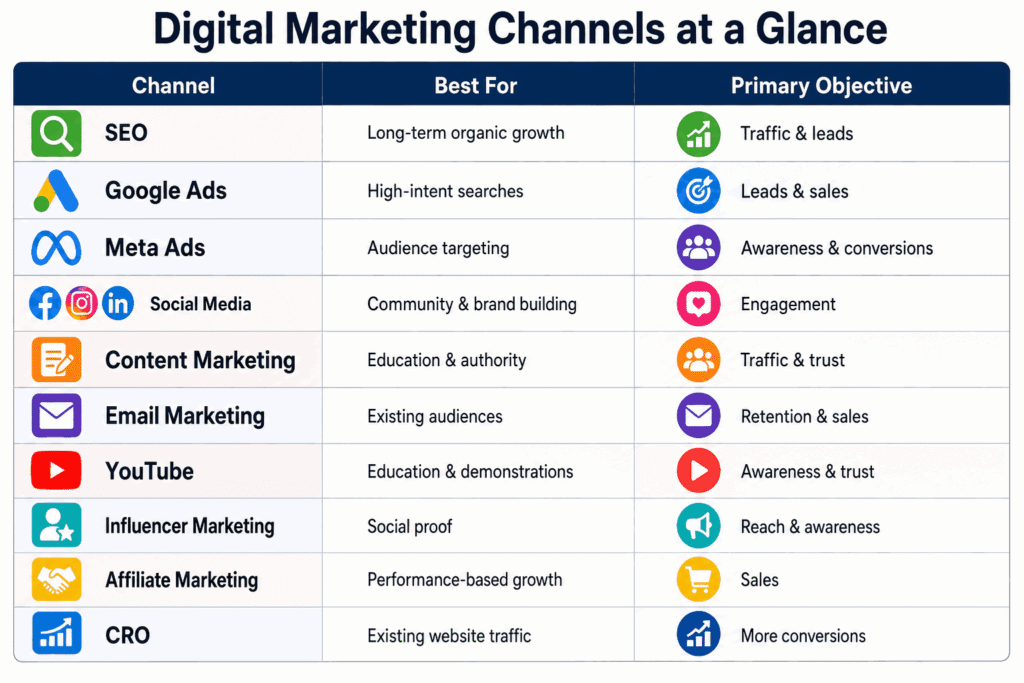
Most modern strategies don’t treat these as competitors — many established businesses still use hoardings or print alongside digital. The difference is that digital channels are now where most buying decisions actually begin.
Types of Digital Marketing
Digital marketing isn’t one thing — it’s a set of channels that work together. Here are the ones every beginner should know.
1. Search Engine Optimization (SEO)
SEO is the process of improving a website so it ranks higher in search engine results — like Google — for terms people are actually searching. It’s free traffic in the sense that you don’t pay per click, but it takes time and consistent effort to build. Most experienced marketers recommend learning SEO first, since it underpins content marketing, local marketing, and even how paid ads perform.
2. Pay-Per-Click Advertising (PPC / SEM)
PPC is paid search advertising — think of the sponsored results at the top of a Google search. Platforms like Google Ads let businesses bid on keywords and pay only when someone clicks. Unlike SEO, results are near-instant, which makes PPC useful for testing what works before committing to a longer-term SEO strategy.
3. Content Marketing
This is the creation of useful, relevant content — blog posts, guides, videos, infographics — designed to attract and inform an audience rather than sell to them directly. Content marketing and SEO are closely linked: good content is what actually ranks in search results, and it’s what keeps visitors on a site once they arrive.
4. Social Media Marketing
Promoting a brand through platforms like Instagram, Facebook, LinkedIn, and X — both organically (regular posts, Reels, engagement) and through paid ads. The right platform depends entirely on where the target audience spends time; a B2B consulting firm and a fashion brand will rarely use the same channels the same way.
5. Email Marketing
Despite being one of the oldest digital channels, email marketing consistently delivers some of the strongest returns because it reaches people who’ve already opted in. It’s used for newsletters, promotional offers, and automated sequences that nurture a lead from first contact to purchase.
6. Affiliate Marketing
A performance-based model where a business pays external partners (affiliates) a commission for traffic or sales they generate — common in e-commerce and SaaS products.
7. Influencer Marketing
Partnering with individuals who have an engaged following — from mega-influencers to niche local creators — to promote a product authentically. This channel has grown especially fast in India, where short-form video creators often have more direct influence over local buying decisions than traditional celebrity endorsements.
8. Video Marketing
Content built specifically for video platforms — YouTube, Instagram Reels, YouTube Shorts. Video has become one of the fastest-growing formats for both discovery (how people find a brand) and retention (why they stay engaged with it).
9. Mobile & WhatsApp Marketing
Particularly relevant in mobile-first markets like India, this includes SMS campaigns, app-based promotions, and WhatsApp Business tools — used heavily by local service businesses for appointment reminders, order updates, and direct customer communication.
How Digital Marketing Works: The Basic Funnel
Most digital marketing strategies — regardless of channel — move a potential customer through a similar journey:
- Awareness — the customer discovers the brand exists (through SEO, social media, or an ad)
- Consideration — they research further, compare options, read reviews or content
- Conversion — they take the desired action: a purchase, a sign-up, a booking
- Retention — post-purchase engagement (email, loyalty offers, remarketing) that turns a one-time buyer into a repeat customer
A good strategy maps specific channels to specific stages, rather than trying to do everything everywhere — SEO and content tend to drive awareness and consideration, while email and retargeting ads are more effective for conversion and retention.
Key Elements of a Digital Marketing Strategy
Picking channels is only half the job — a strategy is what ties them together so effort in one area supports the others. Most working strategies, however simple, cover the same five elements:
- A specific goal — more website traffic, more leads, more direct sales — stated clearly enough to measure
- A defined audience — who the customer actually is, not “everyone,” since channel choice and messaging both depend on this
- A channel mix — usually 1–3 channels to start, chosen based on where that specific audience spends time
- A content or campaign plan — what gets published or run, and on what schedule, rather than posting reactively
- KPIs to track — the specific numbers (traffic, click-through rate, conversion rate, cost per lead) that define whether it’s working
Beginners often skip straight to “posting content” or “running ads” without the first two elements in place — which is usually why results feel random instead of improving over time.
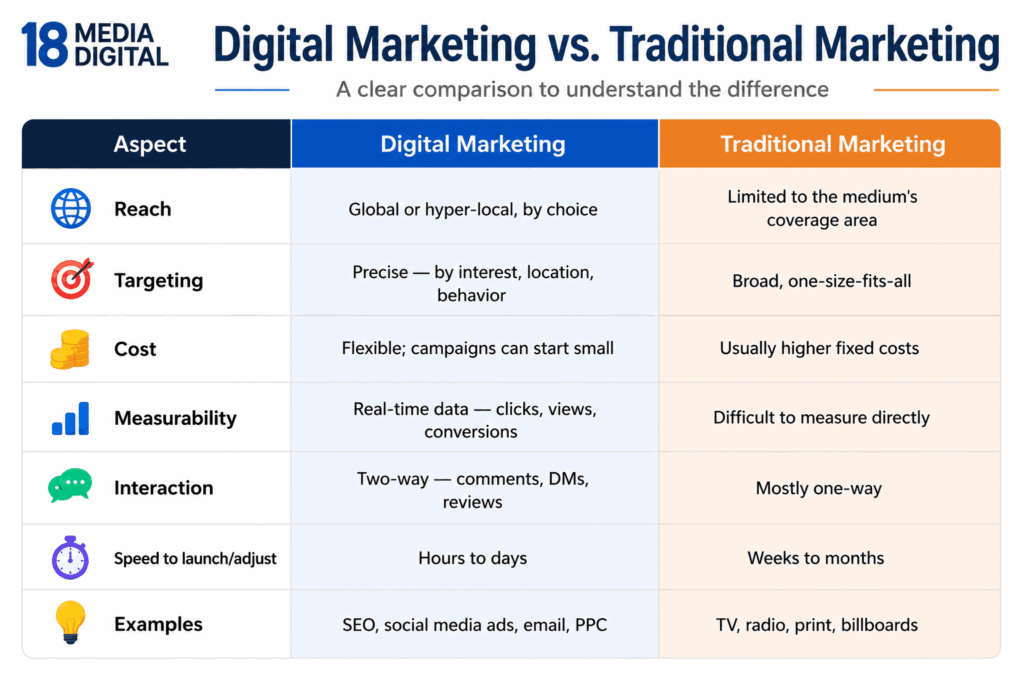
Most of these have free tiers, which is one reason digital marketing is accessible even without a big budget.
Skills You Need to Get Started
- Writing — clear, persuasive communication is central to almost every channel
- Basic data literacy — reading analytics well enough to know what’s working
- SEO fundamentals — even non-SEO specialists benefit from understanding it
- Some design sense — not professional design skill, but an eye for what looks clean and on-brand
- Adaptability — platforms, algorithms, and best practices change constantly; comfort with continuous learning matters more than mastering any one tool
How to Start Learning Digital Marketing
- Pick one channel to go deep on first — trying to learn SEO, PPC, social, and email all at once tends to produce shallow knowledge of everything and mastery of nothing
- Use free or low-cost certifications — Google Digital Garage, HubSpot Academy, and Meta Blueprint all offer beginner-friendly, credible courses
- Practice on a real project — a personal blog, a friend’s small business, or even a hypothetical brand gives you results to actually analyze
- Track outcomes, not effort — the goal is learning what moves the needle, which only shows up in the data
- Stay current — search algorithms, ad platforms, and social features change often enough that ongoing learning is part of the job, not a one-time step
Common Mistakes Beginners Make
- Starting campaigns without a clear, specific goal
- Trying every channel at once instead of going deep on one first
- Giving up on SEO because it doesn’t show results in week one
- Not tracking data — running on instinct instead of evidence
- Copying what competitors do without understanding why it works for their specific audience
Conclusion
Digital marketing is not a single skill; it is a combination of different channels, strategies, tools, and techniques designed to achieve specific business goals. A strong Digital Marketing Introduction helps beginners understand how these channels work and when to use them. Businesses do not need to use every channel at once. Instead, they should identify where their target audience spends time, choose the most relevant platforms, set clear goals, and measure performance. A practical Digital Marketing Introduction should also explain the importance of testing, analysing results, and improving campaigns over time. For beginners, learning one channel at a time can make the process easier and more effective. Whether your goal is to build a career, promote a personal brand, or grow a business, a structured Digital Marketing Introduction provides a strong foundation. Start with one area, understand its fundamentals, practise regularly, track your results, and use data to decide what you should learn or implement next.
Follow 18 Media Digital on Social Media
Want to stay updated with the latest digital marketing tips, SEO strategies, social media trends, advertising insights, and business growth ideas?
Follow 18 Media Digital on our social media channels:
- Instagram: Follow 18 Media Digital on Instagram
- Facebook: Follow 18 Media Digital on Facebook
- LinkedIn: Follow 18 Media Digital on LinkedIn
- Pinterest: Follow 18 Media Digital on Pinterest
- X (Twitter): Follow 18 Media Digital on X
- YouTube: Subscribe to 18 Media Digital on YouTube
Follow 18 Media Digital and stay connect
Frequently Asked Questions About Digital Marketing Introduction
1. What is Digital Marketing Introduction?
Digital Marketing Introduction is the starting point for understanding how businesses use digital channels such as search engines, websites, social media, email, online advertising, and video platforms to reach their target audience.
2. Why is Digital Marketing Introduction important for beginners?
A Digital Marketing Introduction helps beginners understand the basic concepts before moving into advanced areas. It explains digital marketing meaning, definition, types, channels, benefits, strategies, and practical examples in an easy-to-understand way.
3. What topics are covered in Digital Marketing Introduction?
A complete Digital Marketing Introduction generally covers what digital marketing is, how it works, its major types, digital marketing channels, customer journey, marketing funnel, benefits, tools, strategies, and real-world examples.
4. Is Digital Marketing Introduction useful for students?
Yes. Digital Marketing Introduction provides students with a foundation in important areas such as SEO, content marketing, social media marketing, PPC, email marketing, analytics, and online advertising. It can be a useful starting point for further learning and practical projects.
5. How can I learn Digital Marketing Introduction?
You can learn Digital Marketing Introduction through beginner-friendly blogs, courses, videos, practical projects, and hands-on experience. Start with the fundamentals, understand how each digital channel works, and gradually move toward advanced digital marketing strategies
Leave a Reply