

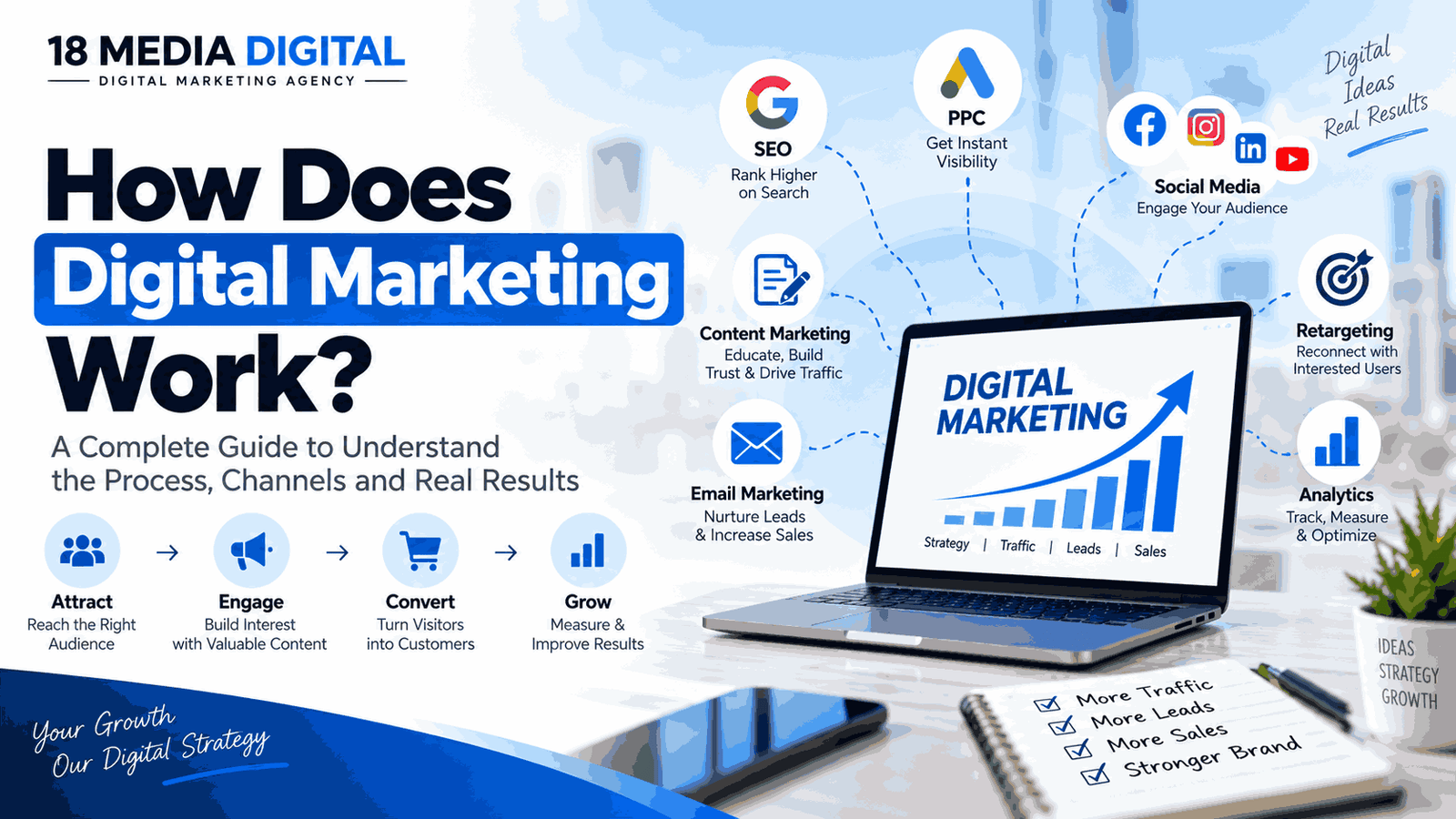

How Does Digital Marketing Work? It works by connecting businesses with potential customers through digital channels and guiding them from awareness to action. Unlike traditional marketing, digital marketing uses data, technology, and measurable interactions to understand what people search for, view, click, and purchase online. Every click, search, and interaction helps businesses make smarter marketing decisions instead of relying on guesswork.
To understand How Does Digital Marketing Work, start with search engines. When someone searches for a product or answer, search engines analyze hundreds of ranking signals, including content relevance, website quality, user experience, page speed, mobile-friendliness, and authority. Businesses improve their organic visibility through SEO by creating helpful content and optimizing their websites to match user intent.
Advertising works differently. Instead of waiting for organic rankings, businesses can use PPC advertising to appear instantly for relevant searches. Google Ads and similar platforms use automated auctions to decide which ads are shown and how much advertisers pay. Understanding this auction system is another important part of How Does Digital Marketing Work, because success depends on both bidding strategy and ad quality—not just budget.
Another key element is retargeting. When someone visits a website but leaves without taking action, advertising platforms can use permitted tracking technologies to show relevant ads later across participating websites, apps, and social media. This keeps the brand visible and encourages potential customers to return when they’re ready to buy.
How Search Engines Work (and Where SEO Fits In)
Search engines operate through three essential stages: crawling, indexing, and ranking. Crawling discovers new webpages, indexing stores and categorizes their content, and ranking determines which pages deserve the highest positions for a specific search query. SEO is the practice of improving a website so it performs well across these stages. In 2026, AI-generated search summaries are becoming more common, making clear, well-structured, and authoritative content even more valuable. This is why understanding How Does Digital Marketing Work begins with understanding how search engines evaluate content.
How PPC Auctions Actually Work
Pay-per-click advertising is much more sophisticated than simply rewarding the highest bidder. Platforms combine an advertiser’s bid with quality signals such as ad relevance, expected performance, and landing-page experience to calculate overall ad rank. This allows smaller businesses with highly relevant campaigns to compete against larger competitors with bigger budgets. Knowing this auction process helps explain How Does Digital Marketing Work in paid advertising, where optimization often matters more than spending the most money.
How Social Media Algorithms Decide What You See
Social platforms rank content in a user’s feed based on signals like how much engagement a post is getting, how recent it is, and how closely it matches what that specific user has engaged with before. Paid promotion works alongside this system rather than replacing it — a paid boost gets a post in front of more people, but engagement still affects how far it spreads afterward. This is why a well-performing organic post amplified with a small paid budget often outperforms a purely paid post with weak engagement.
How Retargeting Actually Works
To understand Does Digital Marketing Work, it is useful to see how retargeting brings previous website visitors back. Retargeting is a digital advertising technique that focuses on people who have already interacted with a business online. A website may use an advertising tag, pixel, cookie, or another permitted tracking technology to record an eligible visit. When a visitor views a product but leaves without purchasing, the business can potentially include that visitor in a retargeting audience, depending on consent, browser settings, platform policies, and available data.
For example, imagine someone visits an online shoe store and looks at running shoes. They leave without buying. Later, they may see an advertisement for the same brand on a participating website, app, or social media platform. The purpose is to remind an interested visitor about the product and encourage them to return.
This also explains Does Digital Marketing Work as part of a broader customer journey. Retargeting does not guarantee a conversion, but it can reconnect businesses with people who have already shown interest.
How It All Connects: A Simple Example
Consider someone searching Google for “running shoes.” They click an organic result because the website has relevant SEO content. After reading the article, they browse several products but leave without purchasing.
If appropriate tracking has been implemented and the visitor qualifies for a retargeting audience, the business may later show them a relevant PPC advertisement. The visitor clicks the ad, returns to the website, and signs up for an email discount.
The business can then use permission-based email marketing to send useful product information, offers, or reminders. Eventually, the visitor may return and complete the purchase.
This example demonstrates Does Digital Marketing Work through multiple connected channels rather than one isolated campaign. SEO creates discovery, the website provides information, retargeting encourages a return visit, PPC generates another opportunity to interact, and email supports follow-up.
Ultimately, Does Digital Marketing Work depends on how effectively these channels work together, how well the business understands its audience, and how consistently it measures and improves each stage of the customer journey.
Conclusion
Understanding How Does Digital Marketing Work helps businesses move beyond simply using online channels and start building a clear, measurable strategy. Search engines use ranking systems to decide which content appears for relevant searches, while PPC platforms use ad auctions to determine which advertisements are shown to users. Social media algorithms help deliver content to audiences based on different signals, and tracking technologies can support retargeting and campaign measurement. How Does Digital Marketing Work becomes easier to understand when these mechanisms are viewed as connected parts of the customer journey. A person may first discover a brand through search, interact with its social content, visit its website, and later see a relevant advertisement. How Does Digital Marketing Work is ultimately about reaching the right audience, delivering useful messages, measuring actions, and improving performance. By understanding these processes, marketers can make informed decisions, test strategies, identify opportunities, and continuously improve their digital marketing results.
Follow 18 Media Digital on Social Media
keting strategies, SEO, content marketing, social media marketing, paid advertising, and other digital solutions.
Want to stay updated with the latest digital marketing tips, SEO strategies, social media trends, advertising insights, and business growth ideas?

Follow 18 Media Digital on our social media channels:
Follow 18 Media Digital and stay connect
Website: 18 Media Digital
Contact: 9854991818
Location: 1st Floor, D17, Airport Rd, near Belsare Hospital, Kasturba D, Kasturba Housing Society, Vishrantwadi, Pune, Maharashtra 411015
Frequently Asked Questions
How does Google actually decide search rankings?
To understand How Does Digital Marketing Work, it helps to know that search engines crawl and index pages before ranking them using signals such as content relevance, site speed, mobile-friendliness, and backlinks. Rankings are not based on manual review of every page.
How do social media algorithms work?
How Does Digital Marketing Work on social media depends partly on algorithms that prioritize content based on factors such as engagement, recency, and relevance to an individual user’s past activity. This means users may see different content in different orders.
How does retargeting know what I looked at online?
Retargeting is another example of How Does Digital Marketing Work in practice. A tracking pixel placed on a website can record a visit, allowing advertising platforms to show relevant ads to that visitor later on participating websites and platforms.
Do I need to understand these mechanics to do digital marketing well?
You do not need to understand every technical detail, but knowing How Does Digital Marketing Work can help explain why some campaigns underperform despite having a good budget. Understanding ranking systems, advertising auctions, targeting, and measurement can help marketers make better decisions and improve campaign performance.



Leave a Reply