
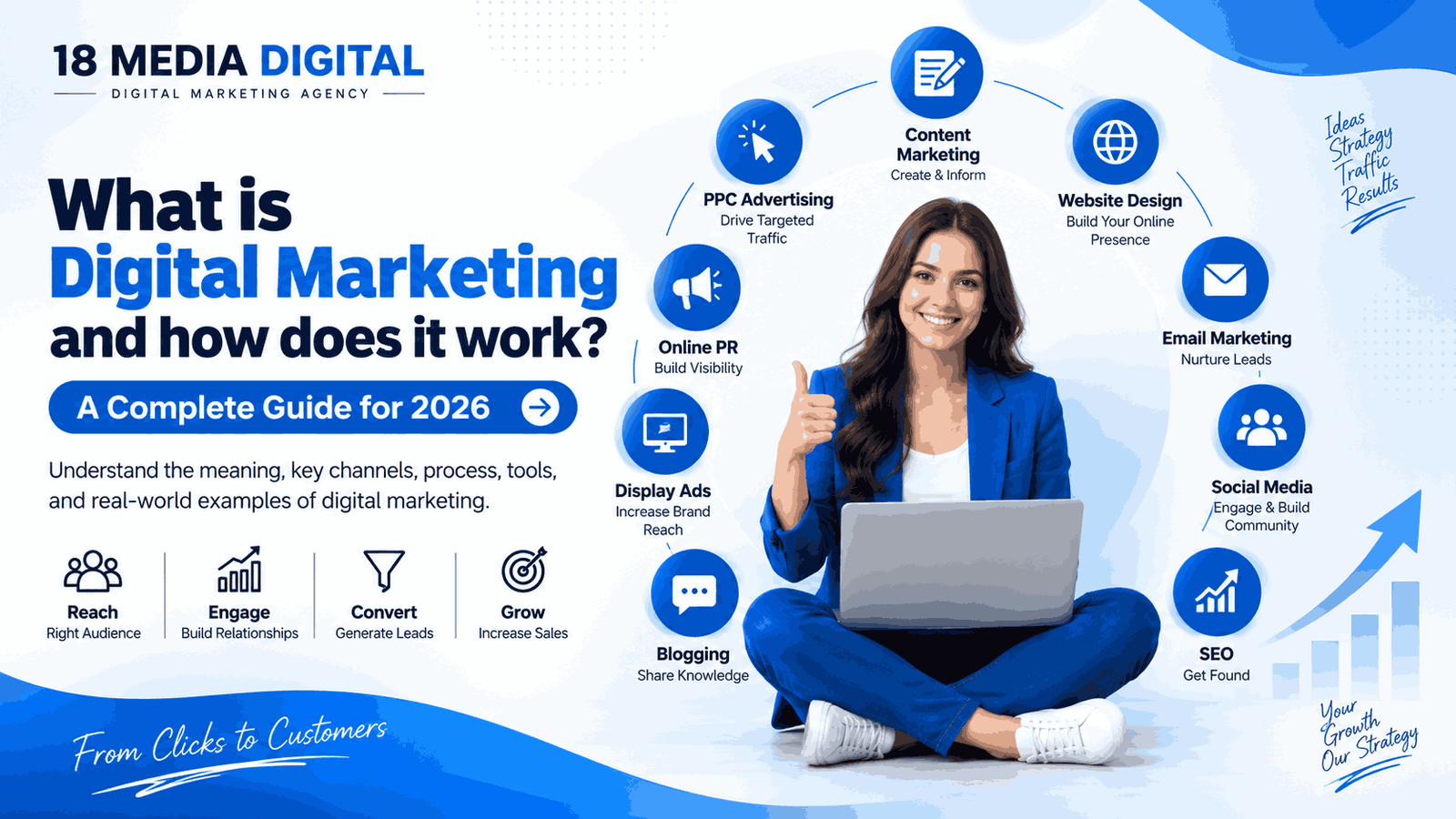

Digital marketing isn’t just one job or one activity. It is a combination of different roles that help a business attract, engage, convert, and retain customers online. What is Digital Marketing and how does it work becomes easier to understand when we look at the people and responsibilities behind each marketing activity.
Businesses often measure digital marketing through outcomes such as increased website traffic, more leads, higher sales, stronger brand awareness, and better customer engagement. However, these results come from different specialists working on specific areas. What is Digital Marketing and how does it work depends on how these roles work together toward common business goals.
A digital marketing manager or strategist usually plans the overall direction, while SEO specialists improve search visibility, content writers create useful information, and social media managers build audience engagement. Paid advertising specialists manage campaigns, email marketers nurture leads, and analytics professionals measure performance. What is Digital Marketing and how does it work also includes automation, influencer marketing, conversion optimization, and emerging AI-focused marketing activities.
For beginners, understanding What is Digital Marketing and how does it work can help identify which role matches their skills and interests. Some people may enjoy writing and choose content or SEO, while others may prefer numbers, creativity, strategy, advertising, or relationship building.
This guide explores the major digital marketing roles, their responsibilities, important skills, common tools, and the roles that are seeing strong demand in 2026.
The Overall Role of Digital Marketing in a Business
At a strategic level, digital marketing’s role is to connect business goals — more customers, more sales, more repeat business — to the digital channels where those customers already spend their time. It translates a broad goal like “grow revenue 20% this year” into specific, executable work: which channels to use, what content to create, how much to spend, and how to measure whether any of it is working.
That translation, from a business goal on a whiteboard to daily, trackable execution, doesn’t happen through one generalist role. It happens through specialization. A strategist decides direction, but an SEO specialist, a paid ads manager, and a content writer are the ones who actually move the needle — each in a different, measurable way. That division of labor is exactly where the 10 roles below come in.
10 Key Roles in Digital Marketing, Explained
1. Digital Marketing Manager / Strategist
This role sets overall direction — deciding which channels to prioritize, setting budgets, and making sure every other role is working toward the same business goal rather than in isolation. Strategists typically come from a specialist background (often SEO, paid ads, or content) and move into overseeing the bigger picture once they’ve proven results in one area first.
Key skills: Strategic planning, budget management, cross-channel coordination, stakeholder communication.
Common tools: Google Analytics, project management software, marketing dashboards.
2. SEO Specialist
Responsible for improving a website’s visibility on search engines through keyword research, on-page optimization, technical fixes, and backlink building. This role plays the long game — SEO results build gradually over months, not days — but the traffic it earns keeps compounding long after the work is done, which is why it remains one of the most valuable roles on a marketing team.
Key skills: Keyword research, technical auditing, content optimization, competitor analysis.
Common tools: Google Search Console, SEMrush, Ahrefs.
3. Content Strategist / Writer
Plans and produces the blogs, guides, videos, and other content that attract and educate an audience. This role works closely with SEO, since well-optimized content is what most organic search traffic is actually built on, and increasingly works alongside AI writing tools to plan and structure content faster without losing quality or accuracy. Key skills: Writing, editorial planning, audience research, basic SEO knowledge.
Common tools: Content calendars, Google Docs, SEO writing assistants.
4. Social Media Manager
Manages a brand’s presence, posting schedule, and community engagement across platforms like Instagram, Facebook, LinkedIn, and YouTube. Increasingly, this role also manages paid social campaigns, not just organic posting, blurring the line between this role and the paid ads specialist role below.
Key skills: Content creation, community management, trend awareness, basic design skills.
Common tools: Meta Business Suite, Canva, scheduling platforms like Buffer or Hootsuite.
5. PPC / Paid Ads Specialist
Manages paid search and paid social campaigns — setting up ads, managing bids and budgets, and continuously testing what converts best. This role is judged heavily on measurable performance, since every rupee spent is trackable, which is also why it tends to be one of the higher-paying specialist roles on this list.
Key skills: Campaign setup, bid management, A/B testing, budget optimization.
Common tools: Google Ads, Meta Ads Manager.
6. Email Marketing Specialist
Builds and manages email campaigns, from welcome sequences to promotional blasts, focused on nurturing leads and retaining existing customers. This role often owns some of the highest-ROI campaigns in the entire marketing mix, since it’s marketing to people who’ve already shown interest rather than reaching cold audiences.
Key skills: List segmentation, copywriting, automation workflows, basic analytics.
Common tools: Mailchimp, Klaviyo, HubSpot.
7. Marketing Automation Specialist
Sets up the behind-the-scenes systems that trigger emails, score leads, and move prospects through a funnel without manual effort from the team. This role has grown significantly as AI-driven automation has become more central to how campaigns run, taking on tasks that used to require a person to execute manually at every step.
Key skills: Workflow design, CRM management, basic data analysis, systems thinking.
Common tools: HubSpot, Marketo, Zapier.
8. Data / Analytics Specialist
Tracks performance across every channel and translates raw numbers into decisions the rest of the team can act on — which campaigns to scale, which to cut, and why. This role is what makes every other role’s work measurable rather than a guess, and it’s increasingly treated as a leadership pipeline role rather than a purely technical one.
Key skills: Data analysis, reporting, dashboard building, statistical thinking.
Common tools: Google Analytics, Looker Studio, Excel or Google Sheets.
9. Influencer Marketing Manager
Identifies, negotiates with, and manages relationships with content creators who can promote a brand to their existing audience. This role has become its own specialty as influencer marketing has grown into a dedicated budget line for many brands, rather than an occasional one-off collaboration.
Key skills: Relationship management, negotiation, campaign tracking, content review.
Common tools: Influencer marketplace platforms, spreadsheets for outreach tracking.
10. Conversion Rate Optimization (CRO) Specialist
Focuses on what happens after someone lands on a website or landing page — testing headlines, layouts, and calls to action to improve how many visitors actually convert into leads or customers. This role often works closely with both paid ads and web design teams, since a beautifully designed page that doesn’t convert is still a failed campaign.
Key skills: A/B testing, basic UX principles, data interpretation, copywriting.
Common tools: Heatmap tools like Hotjar, landing page builders, analytics platforms.
Quick Reference: All 10 Roles at a Glance
| Role | Primary Focus | Best Suited For |
|---|---|---|
| Digital Marketing Manager | Overall strategy and coordination | Experienced generalists moving into leadership |
| SEO Specialist | Organic search visibility | Patient, detail-oriented researchers |
| Content Strategist / Writer | Blogs, guides, video content | Strong writers and communicators |
| Social Media Manager | Brand presence and engagement | Creative, trend-aware communicators |
| PPC / Paid Ads Specialist | Paid search and social campaigns | Comfortable with fast, measurable pressure |
| Email Marketing Specialist | Lead nurturing and retention | Detail-oriented writers who like segmentation |
| Marketing Automation Specialist | Behind-the-scenes workflows | Systems-minded, process-driven thinkers |
| Data / Analytics Specialist | Performance tracking and reporting | Analytical, pattern-focused thinkers |
| Influencer Marketing Manager | Creator partnerships | Relationship-builders and negotiators |
| CRO Specialist | Landing page and funnel optimization | Curious testers who like iterating |
An Emerging 11th Role: AI Marketing Specialist
Job postings for AI-focused marketing roles grew sharply year over year heading into 2026, making AI fluency one of the most in-demand skills in the field. This role sits somewhere between the strategist and the automation specialist above — using AI tools for campaign planning, content generation, and performance prediction, while making sure a human is still directing the strategy behind it. It’s not yet a role every company has, but it’s one of the fastest-growing additions to digital marketing teams right now.
Skills That Matter Across Every Role
A few skills show up on almost every job description above, regardless of specialization. Basic comfort reading analytics data matters even for a content writer, since knowing which posts actually perform shapes what gets written next. Clear communication matters even for a highly technical SEO specialist, since results need to be explained to non-technical stakeholders. And increasingly, working alongside AI tools — for research, drafting, or campaign analysis — has become a baseline expectation rather than a specialized skill on its own. Specializing in one role doesn’t mean ignoring the others; the strongest professionals in any one of these roles usually understand enough about the rest to collaborate well.
Which of These Roles Are Most in Demand in 2026?
Digital marketing hiring in India has been growing fast, with annual job openings now well into the hundreds of thousands and continued double-digit growth projected over the next few years. Within that overall growth, three roles stand out as the strongest performers: performance marketing (paid ads) specialists, SEO specialists with a growth mindset, and marketing analytics professionals — largely because all three tie directly to measurable revenue impact, which is what companies are prioritizing in hiring right now. Performance marketing in particular tends to pay the most among specialist roles, since managing large ad budgets effectively has a direct, visible impact on the bottom line.
Demand also varies by industry. IT services and SaaS companies hire heavily for content and performance marketing roles to support B2B lead generation, e-commerce brands lean hard on performance marketing and CRO specialists to drive direct sales, and education and financial services companies have been steadily expanding their content and SEO teams as they compete for organic visibility. A beginner targeting a specific industry can use this to narrow down which of the 10 roles to prioritize learning first.
How These Roles Work Together
In a large company, these 10 (or 11) roles are often held by different people, sometimes split across multiple teams — a growth team handling paid ads and analytics, a content team handling SEO and writing, a separate team for social and community. In an agency setting, the same roles exist but are often shared across multiple client accounts, with one specialist handling, say, SEO for five different clients rather than one.
In a small business or startup, it’s common for one or two people to cover several of these roles at once — a founder might personally handle social media and email, while outsourcing SEO and PPC to a freelancer or agency. A solo freelancer, meanwhile, often ends up being a generalist across most of these roles for each individual client, even while specializing in one or two of them more deeply for their own positioning. The roles themselves don’t change based on company size or structure; what changes is how many people are needed to cover them, and how specialized each person can afford to be.
How to Choose the Right Role for You
With 10-plus roles to choose from, beginners often default to whichever one seems easiest to start, which isn’t always the best fit. A few honest questions help narrow it down instead. Do you enjoy writing and explaining things clearly? Content strategy or SEO will likely feel natural. Do you like numbers and finding patterns in data? Analytics or CRO will play to that strength. Do you enjoy negotiating and building relationships? Influencer marketing rewards exactly that. Are you comfortable with a role where performance is judged daily, sometimes hourly? Paid ads suits people who don’t mind that pressure, while SEO suits people who prefer slower, steadier progress. There’s no wrong answer here, but picking a role that matches how you already like to work makes the learning curve considerably shorter than picking one purely because it seems in-demand.
Conclusion
Understanding What is Digital Marketing and how does it work is important for anyone who wants to build a successful online presence, but knowing the definition alone is not enough. The real challenge comes from understanding how different channels, algorithms, audiences, content, and measurement work together in practice. What is Digital Marketing and how does it work becomes much clearer when you look beyond basic definitions and focus on how real campaigns attract visitors, generate leads, build relationships, and support sales.
A major part of What is Digital Marketing and how does it work involves understanding that traffic does not automatically mean conversions. A website may receive many visitors but still produce poor results if the content, targeting, landing pages, or customer journey are not properly planned. Similarly, changes in rankings or engagement should be analyzed carefully before deciding that a strategy has failed.
Learning What is Digital Marketing and how does it work also means understanding the importance of measurement. SEO, content marketing, social media, PPC, email marketing, and other channels each contribute differently to business goals. Tracking the right metrics helps marketers identify what is working and what needs improvement.
Ultimately, What is Digital Marketing and how does it work is best understood through practical experience. Start with a clear strategy, understand your audience, choose suitable channels, create useful content, measure performance, and improve consistently. Focusing on a few important areas and executing them properly can often deliver better results than trying to use every digital marketing channel at once.
18 Media Digital on Social Media
keting strategies, SEO, content marketing, social media marketing, paid advertising, and other digital solutions.
Want to stay updated with the latest digital marketing tips, SEO strategies, social media trends, advertising insights, and business growth ideas?

Follow 18 Media Digital on our social media channels:
Follow 18 Media Digital and stay connect
Website: 18 Media Digital
Contact: 9854991818Location: 1st Floor, D17, Airport Rd, near Belsare Hospital, Kasturba D, Kasturba Housing Society, Vishrantwadi, Pune, Maharashtra 411015
Frequently Asked Questions
What is digital marketing in the simplest terms?
What is Digital Marketing and how does it work can be understood simply as promoting a business through internet-connected channels such as search engines, social media, email, websites, and online advertising. These activities can be tracked and measured, helping businesses understand their marketing performance.
How does digital marketing actually work day to day?
What is Digital Marketing and how does it work in daily practice depends on selecting the right channel for a specific business goal, creating and publishing content or campaigns consistently, and analyzing the resulting data. Marketers use these insights to improve campaigns instead of simply launching them and leaving them unchanged.
What’s the biggest mistake beginners make in digital marketing?
A common mistake is expecting immediate results from every channel. Understanding What is Digital Marketing and how does it work requires recognizing that channels such as SEO may take time to build meaningful traffic and leads. Giving up too early can prevent a strategy from producing long-term results.
Is digital marketing still worth learning with AI doing so much of the work now?
Yes. What is Digital Marketing and how does it work still requires human decision-making. AI can speed up content creation, research, analysis, and other tasks, but marketers still need to develop strategies, understand audiences, interpret results, and make practical decisions based on business goals.
Do these 10 things apply to small businesses as much as large ones?
Yes. What is Digital Marketing and how does it work is especially important for small businesses because they often have limited budgets and resources. Understanding which channels deliver results can help small businesses avoid wasting money and focus their efforts on activities that support traffic, leads, customers, and growth.
How do I know if I’m falling into one of these 10 traps right now?
Review your current marketing reports and ask whether you can explain what each active channel achieved using real numbers. If you cannot clearly identify the results, you may have a measurement problem rather than a strategy problem. Understanding What is Digital Marketing and how does it work helps marketers connect activities with measurable business outcomes.
Leave a Reply