

In an era where consumer attention is entirely dominated by screens, moving a business online is no longer a luxury it is a survival requirement. However, many business owners and aspiring professionals still ask a fundamental question: what is the purpose of digital marketing, and why is it so effective compared to traditional methods?
In this Ultimate Guide 2026, we will explore the core objectives behind online marketing. Whether you are a local entrepreneur trying to scale a retail brand, a B2B supplier hunting for high-value contracts, or a digital marketing fresher practicing technical SEO and keyword optimization to secure a top internship, understanding the true purpose of these tools is the key to driving measurable growth.
Understanding the Core Purpose
At its most basic level, the purpose of digital marketing is to connect a business with its ideal customers exactly where they spend their time: on search engines, social media, and email.
While traditional advertising (like billboards or newspaper ads) broadcasts a generic message to a massive, unfiltered audience, digital marketing acts like a laser. It is designed to capture intent, build relationships, and drive highly specific actions that directly impact the bottom line.
What Is the Purpose of Digital Marketing? 5 Core Objectives
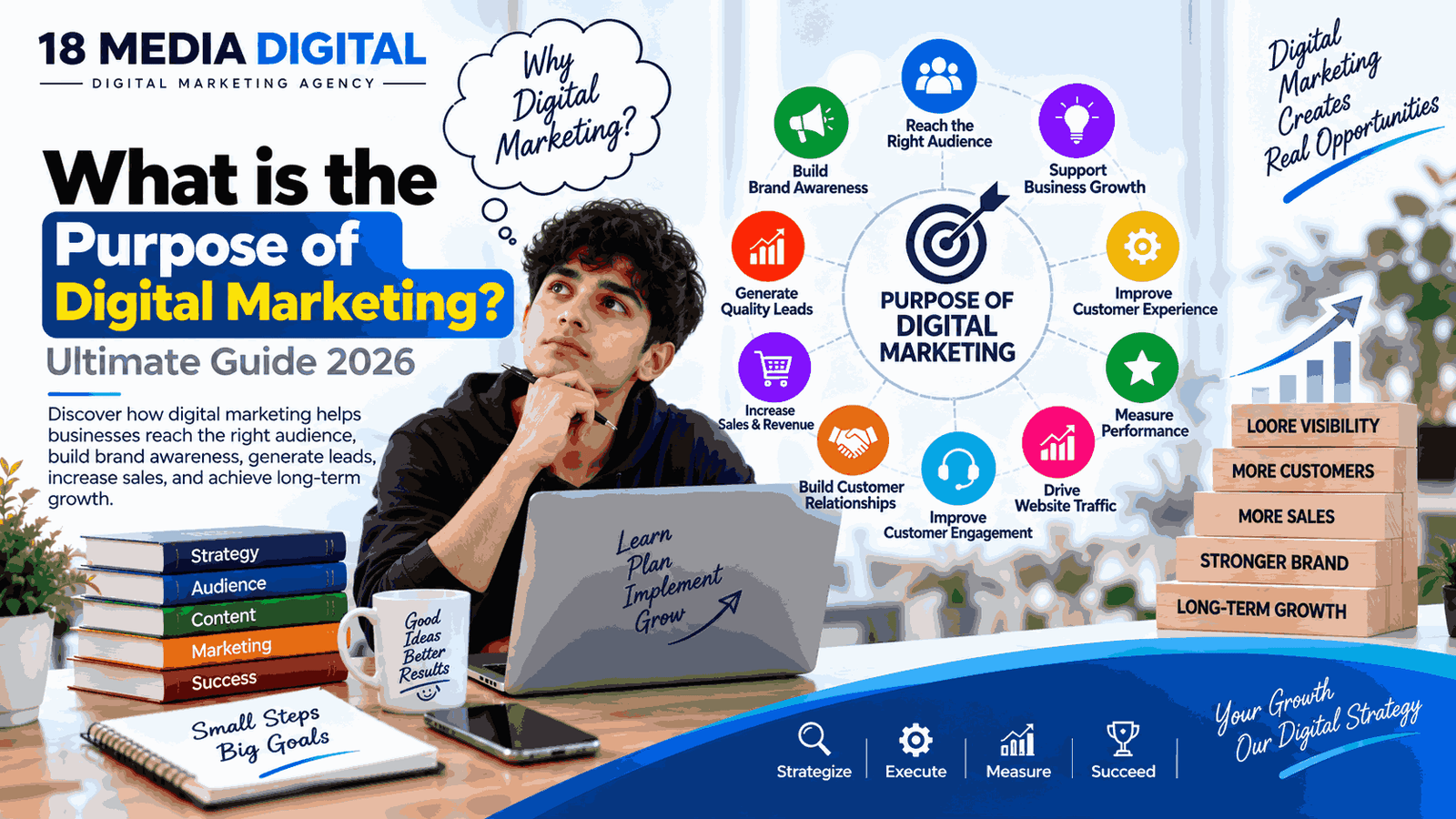
To truly understand what is the purpose of digital marketing, we must break it down into its five most critical objectives.
1. Generating High-Quality Brand Awareness
Before a customer can buy from you, they must know you exist. Digital marketing places your brand in front of people who are already interested in your niche, even if they have never heard of your company.
- The mechanism: Social media algorithms and Search Engine Optimization (SEO) ensure your content reaches relevant users.
- Real-world application: If you are selling premium spice powders directly to consumers (B2C), optimizing your Instagram presence with engaging cooking videos creates immediate visual awareness among food enthusiasts in your specific geographic area.
2. Capturing Intent and Generating Leads
The primary engine of business growth is lead generation. Digital marketing captures the contact information of interested prospects so you can nurture them into paying customers.
- The mechanism: Landing pages, free downloadable guides, and lead-capture forms.
- Real-world application: If a business wants to expand into B2B sales—such as supplying whole spices to luxury hotels—they could run targeted LinkedIn ads offering a “Wholesale Procurement Guide.” When hotel managers download it, the business captures a highly qualified lead.
3. Driving Measurable Sales and Conversions
Unlike traditional marketing, every action in digital marketing is designed to drive a trackable conversion.
- The mechanism: Conversion Rate Optimization (CRO), compelling copywriting, and frictionless checkout processes.
- Real-world application: Designing custom product packaging stickers and pairing them with high-converting promotional voiceover scripts for video ads can drive users directly to an online store, turning a passive viewer into a paying customer in just a few clicks.
4. Retaining Customers and Building Loyalty
It costs significantly more to acquire a new customer than to keep an existing one. A major purpose of digital marketing is post-purchase engagement.
- The mechanism: Automated email marketing, retargeting ads, and community management.
- Real-world application: Setting up an automated email sequence that sends customers a discount code on their birthday, or retargeting past website visitors with ads for a newly released product, ensures your brand stays top-of-mind.
5. Providing Data-Driven Insights
Perhaps the most powerful answer to what is the purpose of digital marketing is its measurability. It removes the guesswork from business growth.
- The mechanism: Analytics tools like Google Search Console and Meta Ads Manager.
- Real-world application: A digital marketing fresher can track exactly which keywords drive the most traffic, how long users stay on a page, and which specific video script generated the highest return on ad spend. This data allows for continuous, highly accurate optimization.
Conclusion
When asking what is the purpose of digital marketing, the answer extends far beyond simply getting “likes” on social media. Its true purpose is to build a predictable, scalable, and highly measurable engine for business growth. By strategically using tools like SEO, paid advertising, and email automation, you can place the right message in front of the exact right person at the precise moment they are ready to buy.
Whether you are a student building a resume by mastering technical SEO for an internship, or an entrepreneur scaling a local product brand into lucrative B2B markets, digital marketing provides the leverage you need. Success ultimately comes down to focused execution. Stop guessing what your customers want, start tracking the data, and adapt your strategies to meet their direct needs. When executed correctly, digital marketing is the most reliable pathway to sustainable revenue in 2026.
Follow 18 Media Digital on Social Media
keting strategies, SEO, content marketing, social media marketing, paid advertising, and other digital solutions.
Want to stay updated with the latest digital marketing tips, SEO strategies, social media trends, advertising insights, and business growth ideas?

Follow 18 Media Digital on our social media channels:
Follow 18 Media Digital and stay connect
Website: 18 Media Digital
Contact: 9854991818Location: 1st Floor, D17, Airport Rd, near Belsare Hospital, Kasturba D, Kasturba Housing Society, Vishrantwadi, Pune, Maharashtra 411015
Frequently Asked Questions (FAQ)
1. What is the purpose of digital marketing for small businesses? For small businesses, what is the purpose of digital marketing boils down to cost-effective growth. It allows local brands to compete with larger corporations by precisely targeting ideal customers in their specific geographic area without requiring massive advertising budgets.
2. What is the purpose of digital marketing when comparing it to traditional advertising? When comparing the two, what is the purpose of digital marketing becomes clear: measurement and targeting. Traditional advertising relies on broad, untrackable reach, while digital marketing targets specific consumer behaviors and provides exact data on return on investment (ROI).
3. What is the purpose of digital marketing for B2B companies? For Business-to-Business operations, what is the purpose of digital marketing centers entirely around lead generation and professional networking. It allows brands to target key decision-makers—like procurement managers—directly through platforms like LinkedIn and automated email nurturing sequences.
4. What is the purpose of digital marketing for a fresher building a career? For someone entering the industry, what is the purpose of digital marketing involves proving technical competence. By mastering skills like keyword optimization, SEO technical practice, and data analytics, a fresher can build a hands-on portfolio that secures competitive agency internships.
Leave a Reply