
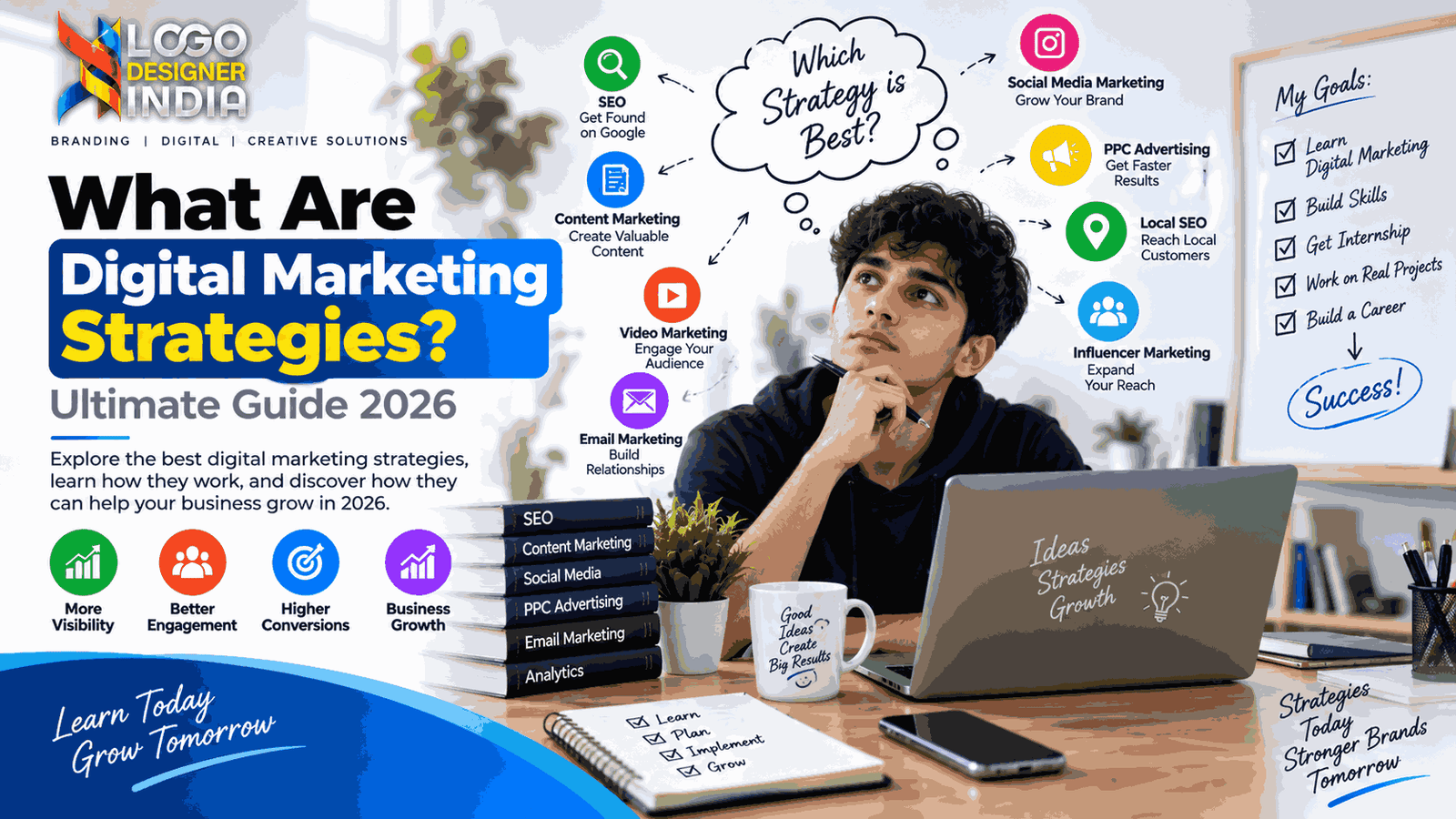

The modern business environment is shifting rapidly, and relying on outdated promotional tactics is a surefire way to be left behind. As AI reshapes search engines and consumer attention spans shorten, adapting to the latest online ecosystems is no longer optional. If you are asking yourself, what are digital marketing strategies, you are taking the critical first step toward building brand authority and driving measurable revenue.
In this Ultimate Guide 2026, we will demystify exactly how digital marketing works today. Whether you are a small business owner looking to scale local retail operations, a B2B supplier trying to land major enterprise contracts, or a digital marketing fresher building a portfolio to secure a competitive agency internship, understanding these foundational strategies is your blueprint for success.
Understanding the 2026 Landscape
A digital marketing strategy is a comprehensive, data-driven plan that leverages online channels—such as search engines, social media, email, and websites—to connect with prospective customers. However, the tactics that worked in 2024 are rapidly becoming obsolete.
Today, users are finding answers directly through AI platforms, looking for authenticity in short-form videos, and demanding hyper-personalized shopping experiences. If you want to know what are digital marketing strategies that actually generate a return on investment (ROI) right now, we must look at the exact frameworks leading the industry.
What Are Digital Marketing Strategies? 7 Proven Methods
To fully answer what are digital marketing strategies, we have broken down the seven most essential frameworks you need to master this year.
1. AI-Powered Marketing Automation
Artificial Intelligence is no longer just a buzzword; it is the engine powering modern marketing. In 2026, AI is deeply integrated into campaign planning, ad targeting, and customer journey automation.
- How it works: Machine learning algorithms analyze massive datasets to predict customer buying behavior and optimize content in real time.
- Real-world application: Instead of sending the same generic email to your entire list, AI tools can automatically segment audiences, sending personalized product recommendations to retail customers while triggering distinct, behavior-based sequences for wholesale clients.
- The benefit: Businesses using AI see reduced ad spend waste and massive improvements in long-term efficiency.
2. Generative Engine Optimization (GEO) and Modern SEO
Traditional Search Engine Optimization (SEO) is evolving. In the past, the goal was simply to rank on page one of Google. Now, with AI Overviews and chat tools dominating search behavior, a growing share of searches end without a single click to a traditional website.
- What this means: You must adapt to Generative Engine Optimization (GEO). This means structuring your content so that AI assistants (like ChatGPT, Gemini, or Perplexity) confidently cite your brand when answering user questions.
- Actionable tip: Focus heavily on long-tail, conversational keywords and structuring your web pages with clear headers, bullet points, and high-value answers to specific niche questions.
3. Performance-Based Advertising (PPC)
When exploring what are digital marketing strategies, Pay-Per-Click (PPC) advertising remains one of the most reliable methods for instant traffic. However, in 2026, advertising budgets are strictly focused on measurable performance.
- How it works: You only pay when a user completes a measurable action, such as a click, lead form submission, or sale.
- The 2026 edge: Due to stricter privacy regulations and the phase-out of third-party cookies, successful campaigns now rely on first-party data and AI-based attribution models to track exactly which ads are generating revenue.
4. Short-Form Video and Authentic UGC
Visual content dominates attention, but polished, corporate-looking ads are losing their effectiveness. Today, consumers crave authenticity.
- User-Generated Content (UGC): Consumers are more likely to buy a product after seeing a real person use it in a TikTok or Instagram Reel. Over 80% of consumers believe UGC improves brand trust and product discovery.
- Actionable tip: Partner with micro-creators or encourage your actual customers to film authentic reviews. Storytelling and genuine connection matter far more than trending audio or high-budget production.
5. Hyper-Personalization and First-Party Data
In 2026, personalization is a consumer expectation, not just a bonus.
- The strategy: Companies are moving away from tracking pixels and instead building “owned audiences.” This means gathering first-party data—like email addresses or phone numbers—directly from users who willingly subscribe to newsletters or community groups.
- The outcome: With this data, you can create tailored experiences across every touchpoint, meaning a user gets recommendations that perfectly align with their past behaviors and preferences.
6. Hyper-Local B2C Strategies
For consumer-facing businesses, local digital marketing is a goldmine. If you are selling a tangible consumer product—like custom-packaged spice powders for home cooks—your strategy must dominate local intent.
- Google Business Profile: Ensure your profile is fully optimized, packed with keywords, and regularly updated with high-quality photos.
- Local SEO content: Write detailed blogs or create landing pages targeting specific regions, offering visual inspiration or practical tips that draw local buyers directly to your storefront or online checkout.
7. B2B Omnichannel Expansion
Business-to-Business (B2B) marketing requires a completely different approach. If a brand wants to scale from selling retail products to supplying wholesale goods—such as securing bulk contracts to provide whole spices to luxury hotels—the strategy must be highly professional and targeted.
- LinkedIn Outreach: Publish industry-specific insights and connect directly with hotel procurement managers.
- Lead Generation Funnels: Use a targeted PPC ad to offer a free “Wholesale Pricing & Quality Guide.” When a manager downloads it, they enter an automated email sequence that nurtures the lead over weeks, eventually prompting a direct sales call.
How to Build Your First Strategy (For Beginners and Freshers)
If you are a student or a fresher trying to figure out what are digital marketing strategies in a practical sense, reading theory is not enough. To secure top internships, you must build a proof-of-work portfolio.
- Step 1: Pick a Niche: Do not try to learn SEO, PPC, and video editing all at once. Pick one discipline (like technical SEO or keyword optimization) and go deep.
- Step 2: Start a Sandbox Project: Launch a WordPress site. Practice structuring blogs, writing voiceover scripts for video ads, or designing custom promotional assets.
- Step 3: Track the Data: Run a small $10 ad campaign or track your organic impressions in Google Search Console. Document the results in a case study to show hiring managers exactly what you are capable of building.
Conclusion
When asking what are digital marketing strategies, the answer boils down to how effectively you can connect with your audience in a digital-first world. The landscape in 2026 demands adaptability. By leveraging AI-powered automation, optimizing for Generative Engine Search, and focusing on hyper-personalized, authentic content, you can bypass the noise and drive real results.
Whether you are launching your career in the marketing space, building localized B2C campaigns, or establishing a robust B2B pipeline, mastering these core methodologies will give you an unparalleled competitive advantage. Start small, track your data, and continually refine your approach to stay ahead.
Follow 18 Media Digital on Social Media
keting strategies, SEO, content marketing, social media marketing, paid advertising, and other digital solutions.
Want to stay updated with the latest digital marketing tips, SEO strategies, social media trends, advertising insights, and business growth ideas?
Follow 18 Media Digital on our social media channels:
Follow 18 Media Digital and stay connect
Website: 18 Media Digital
Contact: 9854991818Location: 1st Floor, D17, Airport Rd, near Belsare Hospital, Kasturba D, Kasturba Housing Society, Vishrantwadi, Pune, Maharashtra 411015
Frequently Asked Questions (FAQ)
1. What are digital marketing strategies for beginners?
For beginners, What are Digital Marketing strategies? The most effective strategies include foundational SEO, building an active presence on one primary social media channel, and creating content that directly answers customer questions. The key is to start with a single channel before expanding.
2. What are digital marketing strategies that work best for B2B?
If you are asking What are Digital Marketing strategies? for B2B businesses, the most useful approaches include LinkedIn marketing, targeted email nurturing sequences, and authoritative content such as whitepapers, guides, and case studies that appeal to industry decision-makers.
3. Why is AI so important in current digital marketing strategies?
Understanding What are Digital Marketing strategies? also means understanding how AI is changing marketing. AI can automate repetitive tasks, help predict customer behavior, and support personalized messaging at scale, helping businesses improve efficiency and make better marketing decisions.
4. How long does it take for a digital marketing strategy to work?
When learning What are Digital Marketing strategies?, it is important to understand that results vary by channel. PPC advertising can generate traffic quickly, while organic strategies such as SEO and content marketing generally require more time to build consistent visibility and compound growth.
Leave a Reply