
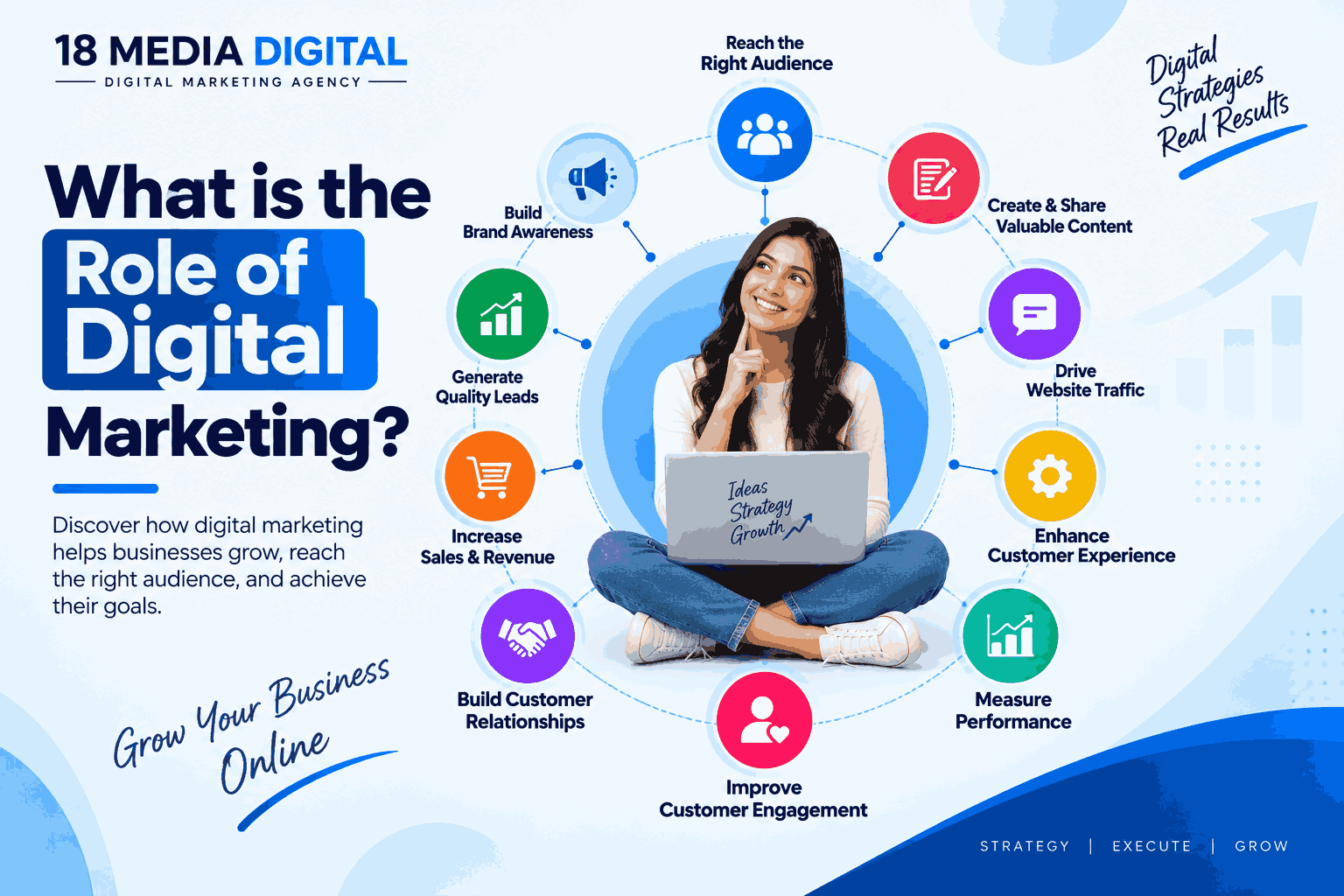

The business ecosystem has increasingly moved online, making digital visibility an important part of modern business growth. If you are wondering What is the role of Digital Marketing, it is to connect businesses with potential customers through search engines, social media, websites, email, content, and online advertising. It helps brands communicate with audiences where they already spend their time.
What is the role of Digital Marketing in a competitive market? One major role is reaching the right audience with relevant messages. Instead of communicating with everyone, businesses can use digital channels and audience data to target people based on interests, location, search behavior, demographics, and other factors. This makes marketing more focused and efficient.
Another important answer to What is the role of Digital Marketing is building brand visibility and trust. Consistent content, social media activity, search presence, and useful information can help a business become more recognizable and credible over time. Digital marketing also supports lead generation by bringing interested visitors to websites, landing pages, and other conversion points.
Finally, What is the role of Digital Marketing when it comes to business performance? It helps companies track important results such as website traffic, engagement, leads, conversions, and sales. These insights allow businesses to understand customer behavior, improve campaigns, manage budgets more effectively, and make informed marketing decisions. From local consumer brands to companies pursuing enterprise contracts, digital marketing can support visibility, customer acquisition, engagement, and long-term growth.
1. Driving Highly Targeted Brand Awareness
Traditional advertising broadcasts a generic message to the masses, hoping a fraction of the audience pays attention. Digital marketing flips this model by guaranteeing your brand is only seen by the people most likely to buy.
- Hyper-Local Targeting: A local business selling custom-packaged spice powders can use localized social media ads to target home cooks within a 10-mile radius.
- Behavioral Targeting: Brands can serve ads strictly to users whose search history indicates they are actively looking for specific products.
- Visual Identity Integration: Awareness is built through consistent branding across platforms, from high-converting website themes to custom product packaging stickers showcased in Instagram Reels.
2. Capturing Search Intent Through SEO
When a consumer has a problem, their first instinct is to search for a solution on Google. The role of Search Engine Optimization (SEO) is to ensure a brand’s website appears at the exact moment that query is typed.
- Keyword Optimization: Identifying the exact phrases users search (e.g., “best wholesale whole spices for hotels”) and naturally weaving them into website copy.
- Technical SEO Practice: Ensuring a WordPress site loads in under three seconds, is fully mobile-responsive, and utilizes proper heading structures so search engines can easily index the content.
- Long-Term Authority: Consistently ranking on page one signals trust to the consumer, making them significantly more likely to convert.
3. Generating High-Value B2B and B2C Leads
Traffic without lead generation is wasted potential. A core function of digital marketing is to capture contact information from interested prospects so the sales team can follow up.
- Lead Magnets: Offering a free, downloadable guide or a discount code in exchange for an email address.
- B2B Procurement: A business expanding into the hospitality sector can run targeted LinkedIn campaigns aimed directly at hotel procurement managers, offering wholesale pricing sheets in exchange for their direct contact details.
- Conversion Rate Optimization (CRO): Continuously testing landing page layouts, button colors, and promotional voiceover scripts to maximize the percentage of visitors who become leads.
4. Nurturing Customer Relationships via Email Automation
Acquiring a lead is only the first step; maintaining that relationship is what drives revenue. What is the role of digital marketing in customer retention? It relies heavily on automated email sequences.
- Welcome Sequences: Automatically sending a series of educational emails immediately after a user subscribes.
- Abandoned Cart Reminders: Triggering an automated message when a user leaves items in their online checkout without purchasing.
- Lifecycle Marketing: Sending personalized birthday discounts or VIP early access to new product launches, ensuring the brand remains top-of-mind year-round.
5. Engaging Audiences with Content Creation
Consumers do not want to be aggressively sold to; they want to be educated, entertained, or inspired. Content marketing serves as the foundation for all other digital channels.
- Blog Structures: Building highly detailed blog structures with visual prompts that answer specific user questions.
- Video Marketing: Drafting multi-part video scripts promoting specialized services—like custom gaming PC setups or student discounts for computer repairs—to engage younger demographics on platforms like YouTube and TikTok.
- Authority Building: Publishing case studies or in-depth guides that prove your company’s expertise in a specific niche.
6. Accelerating Growth with Paid Advertising (PPC)
While organic strategies like SEO take time to compound, Pay-Per-Click (PPC) advertising provides immediate visibility and instant data.
- Search Ads: Bidding on high-intent keywords so your website appears at the very top of Google results instantly.
- Retargeting: Serving targeted display ads to users who previously visited your website but left without making a purchase, gently reminding them to return.
- Cost Control: Advertisers only pay when a user actually clicks the ad, ensuring marketing budgets are spent strictly on engaged prospects.
7. Fostering Community Through Social Media Management
Social media is the digital storefront of 2026. It is where brands build distinct personalities and interact directly with their customer base in real-time.
- Direct Engagement: Replying to comments, hosting live Q&A sessions, and addressing customer service inquiries publicly.
- User-Generated Content: Encouraging existing customers to post photos of their purchases and reposting that content to build authentic social proof.
- Trend Adaptation: Quickly leveraging trending audio or visual formats to increase organic reach.
8. Analyzing Competitor Strategies
Because digital platforms are public, analyzing the competition has never been easier or more accurate. What is the role of digital marketing regarding market intelligence? It allows brands to reverse-engineer success.
- Backlink Analysis: Discovering which high-authority websites are linking to competitors and targeting those same publications.
- Ad Tracking: Using tools like the Meta Ad Library to see exactly what visuals and copy competitors are currently running.
- Gap Identification: Finding keywords or local service areas that competitors are ignoring and aggressively targeting those blind spots.
9. Providing Measurable ROI and Analytics
The most significant advantage of digital marketing over traditional methods is absolute measurability. Every click, view, and purchase is tracked.
- Attribution Modeling: Understanding exactly which touchpoints (e.g., an Instagram ad followed by a Google search) led to a final sale.
- A/B Testing: Running two different versions of a promotional script or landing page simultaneously to see which drives higher conversions based on hard data.
- Portfolio Building: For a fresher building a resume to secure an internship, the ability to showcase measurable data—such as increasing a site’s organic traffic by 40% through targeted keyword optimization—proves practical competence far better than theoretical knowledge.
10. Adapting to Market Trends in Real-Time
A print magazine ad cannot be changed once it goes to press. A digital campaign can be paused, tweaked, or completely overhauled in seconds based on live performance data.
- Budget Reallocation: Immediately moving funds away from underperforming ads and pushing them into the campaigns generating the lowest cost-per-acquisition.
- Seasonal Agility: Launching flash sales or highly specific holiday campaigns within hours to capitalize on sudden market demands.
Conclusion
To truly understand What is the role of Digital Marketing, you must look beyond simple social media posts and vanity metrics. In the modern business landscape of 2026, it serves as the fundamental infrastructure for predictable, scalable growth. Whether you are a fresher building a competitive portfolio to launch your career or a business owner transitioning a local retail product into a wholesale B2B powerhouse, mastering these ten distinct functions gives you unparalleled leverage in the market.
When skeptical entrepreneurs ask, “What is the role of Digital Marketing?”, the most accurate answer is precision and measurement. It empowers you to intercept high-intent consumers exactly when they are actively searching for your specific solution. Traditional advertising relies heavily on hope and broad reach, whereas modern digital frameworks rely on hard analytics, automated relationship nurturing, and targeted conversion rate optimization.
By shifting your focus toward measurable return on investment and continuous technical refinement, you effectively eliminate the guesswork from your promotional strategy. Ultimately, clearly defining What is the role of Digital Marketing for your specific brand dictates how rapidly you can adapt to shifting consumer trends and outpace your competitors. Stop relying on outdated, untrackable methods; audit your current online visibility, optimize your organic search strategy, and begin building a data-driven marketing pipeline that consistently acquires and retains high-value customers.
Follow 18 Media Digital on Social Media
keting strategies, SEO, content marketing, social media marketing, paid advertising, and other digital solutions.
Want to stay updated with the latest digital marketing tips, SEO strategies, social media trends, advertising insights, and business growth ideas?

Follow 18 Media Digital on our social media channels:
Follow 18 Media Digital and stay connect
Website: 18 Media Digital
Contact: 9854991818Location: 1st Floor, D17, Airport Rd, near Belsare Hospital, Kasturba D, Kasturba Housing Society, Vishrantwadi, Pune, Maharashtra 411015
Frequently Asked Questions (FAQ)
1. What is the role of Digital Marketing for small local businesses? For small businesses, understanding what is the role of Digital Marketing centers on targeted, cost-effective visibility. By optimizing a Google Business Profile and running localized social media ads, small operations can effectively compete with much larger brands in their specific geographic area.
2. How does SEO fit into this overall strategy? Search Engine Optimization (SEO) is the foundational method for capturing organic intent. When a user actively searches for a product or service, strong SEO ensures your business is the first authoritative answer they find, reducing reliance on paid ad spend over time.
3. What is the role of Digital Marketing in B2B growth? In Business-to-Business environments, it involves generating high-quality leads for complex sales cycles. It relies heavily on LinkedIn outreach, publishing authoritative industry content, and executing automated email sequences to nurture relationships with procurement managers.
4. How can understanding what is the role of Digital Marketing help my career? Mastering these core functions is essential for anyone entering the field. By demonstrating practical experience in technical SEO, content structuring, and data analysis, professionals can build robust portfolios that instantly prove what is the role of Digital Marketing in driving measurable success for top agencies and corporate teams.

Leave a Reply