
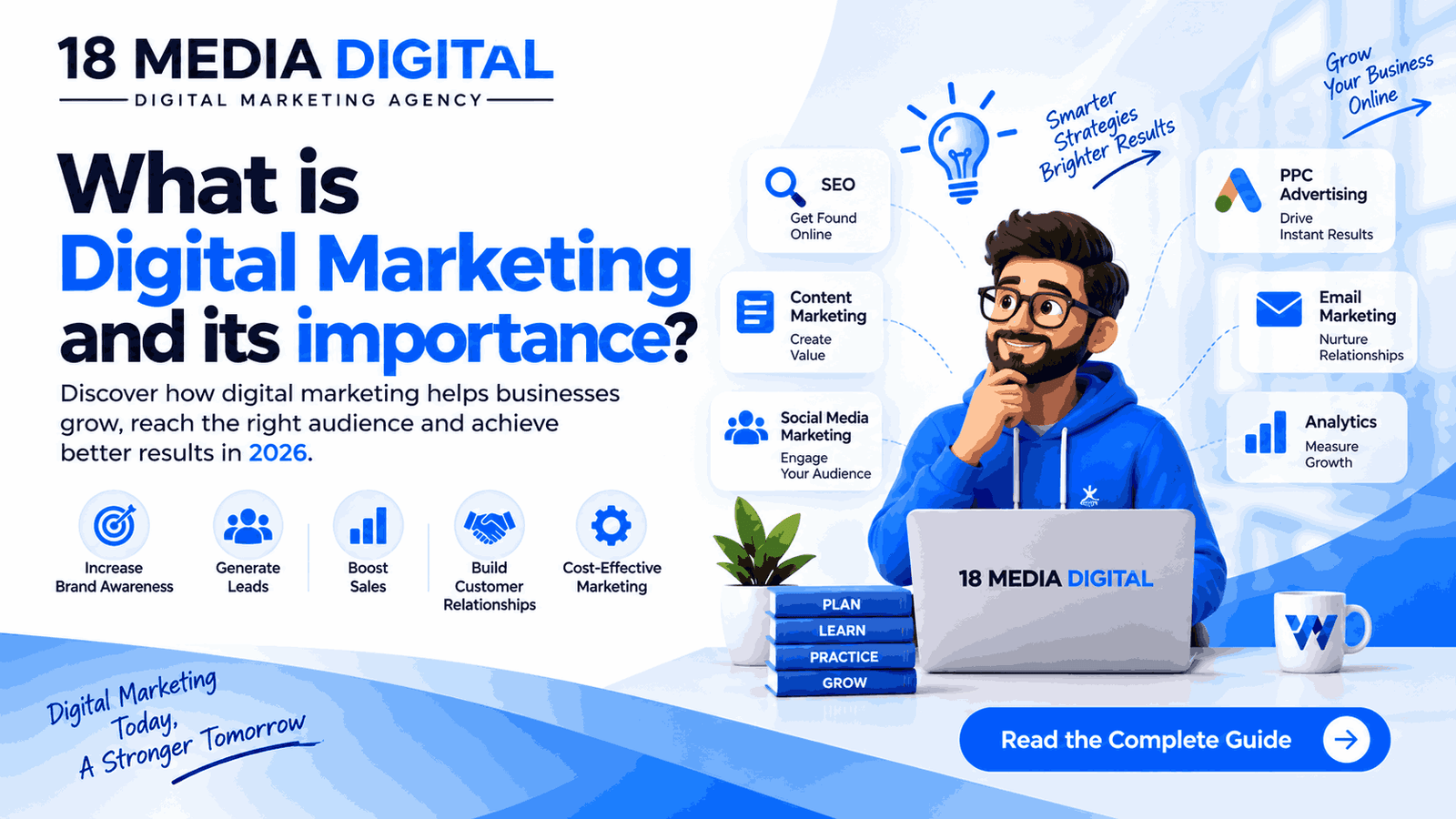

If you are wondering what is digital marketing and its importance?, it starts with understanding how customer behavior has changed in today’s connected world. People now use search engines, social media, websites, email, videos, and online platforms to discover information, compare products, and make purchasing decisions. This shift has made digital marketing an essential part of modern business growth.
Understanding what is digital marketing and its importance? means looking beyond online advertising. It includes strategies such as SEO, content marketing, social media marketing, PPC, email marketing, and analytics that help businesses reach the right audience and build meaningful customer relationships.
In 2026, what is digital marketing and its importance? is especially relevant as businesses compete for attention across multiple digital platforms. Generative AI, search, social media, and personalized online experiences are changing how customers interact with brands.
For businesses, what is digital marketing and its importance? is ultimately about visibility, engagement, leads, conversions, and sustainable growth. A strong digital presence can help brands understand their audience, measure performance, improve campaigns, and compete more effectively in a rapidly changing digital marketplace.
The Core Definition: What Is Digital Marketing?
Digital marketing encompasses any advertising or marketing efforts delivered through digital channels. This includes search engines, websites, social media, email, and mobile apps. Unlike traditional marketing—which broadcasts blindly to the masses via television or print—digital marketing allows you to target specific individuals, track exactly what they do, and measure the precise return on your investment (ROI).
When business owners and aspiring marketers ask what is digital marketing and its importance?, they are often looking for more than a simple definition. Digital marketing has become an important part of modern business because customers increasingly discover, research, and interact with brands online.
Understanding what is digital marketing and its importance? starts with its ability to reach a wider audience through channels such as search engines, social media, websites, email, content, and online advertising. Businesses can select channels based on their audience, goals, and budget.
Another important reason to understand what is digital marketing and its importance? is measurement. Unlike many traditional marketing methods, digital campaigns can provide data about impressions, clicks, website traffic, leads, conversions, and customer engagement. This information helps marketers identify what is working and where improvements are needed.
Finally, what is digital marketing and its importance? becomes clear when considering long-term growth. Businesses can build brand awareness, communicate directly with customers, generate leads, increase sales, and develop stronger relationships through consistent digital strategies. When planned and measured properly, digital marketing can help businesses compete effectively in the modern online marketplace.
1. Unmatched Measurability and Data-Driven ROI
One of the biggest advantages of What is Digital Marketing and its importance? becomes clear when you look at measurement and performance tracking. Traditional advertising methods such as billboards, newspapers, radio, and television can make it difficult to know exactly how many people saw an advertisement and how many actually responded. Digital marketing provides much more detailed information about user behavior.
Businesses can track impressions, clicks, website visits, conversions, leads, purchases, engagement, and other important actions. This information helps marketers understand which campaigns are producing results and which ones need improvement. Instead of relying entirely on assumptions, businesses can make decisions based on actual performance data.
For example, if a PPC campaign is generating quality leads at a reasonable cost, a business can increase its investment in that campaign. If another campaign is spending money without producing meaningful results, the budget can be adjusted or redirected.
In 2026, data-driven marketing is becoming even more advanced through automation, first-party data, and AI-supported analytics. These technologies can help marketers identify patterns, understand customer behavior, and improve campaign performance.
Therefore, What is Digital Marketing and its importance? is strongly connected to measurable results. Businesses can continuously test, analyze, and optimize their marketing activities rather than waiting until the end of a campaign to understand whether it worked.
2. Leveling the Playing Field for Small Businesses
Another important aspect of What is Digital Marketing and its importance? is the opportunity it provides to small businesses. In the past, large companies with huge advertising budgets often had a major advantage because traditional advertising could be expensive and difficult for smaller businesses to scale.
Digital marketing has changed this situation. A small business can use SEO, social media, content marketing, local search, email marketing, and targeted advertising to compete for customer attention without necessarily requiring the same budget as a large corporation.
For example, consider a local business selling spice powders such as Vaishnav Masale. Instead of advertising to an entire country, the business could create targeted campaigns designed to reach specific customers, locations, or business buyers. A search advertisement could potentially appear when a nearby hotel procurement manager searches for bulk whole spices.
This type of targeting can make marketing more efficient because the business can focus its resources on audiences that are more likely to be interested in its products or services.
This explains why What is Digital Marketing and its importance? matters particularly for startups, local businesses, and small companies. Digital channels can provide opportunities to compete through relevance, creativity, targeting, and consistency instead of relying only on advertising budgets.
3. Hyper-Targeting and Personalization at Scale
Modern customers expect businesses to provide relevant experiences. Digital marketing allows brands to target audiences using different characteristics, including location, interests, demographics, search behavior, previous interactions, and other available signals.
Understanding What is Digital Marketing and its importance? therefore requires understanding personalization. A campaign designed for a specific audience can often be more relevant than a general advertisement shown to everyone.
For example, an online clothing store may show different products to users based on their browsing behavior or previous interactions. A business selling professional software may create separate campaigns for startups, small businesses, and large organizations because each group can have different needs.
AI is also influencing personalization in 2026. AI-powered systems can assist businesses with customer segmentation, recommendations, content variations, predictive insights, and campaign optimization. However, effective personalization still requires responsible data use, clear strategy, and an understanding of customer expectations.
The goal is not simply to collect more customer information. The goal is to use relevant information to create better experiences and more useful communication.
As a result, What is Digital Marketing and its importance? includes the ability to deliver the right message to the right audience at a relevant stage of the customer journey.
4. Navigating Nonlinear Customer Journeys
Customer journeys are no longer as simple as seeing an advertisement and immediately purchasing a product. Modern customers may interact with a brand several times before making a decision.
A potential customer might discover a business through Google Search, visit its website, watch a YouTube review, check its Instagram page, read customer reviews, compare competitors, and finally return through a paid advertisement before making a purchase.
This makes understanding What is Digital Marketing and its importance? especially important for businesses that want to remain visible across multiple touchpoints.
A strong digital strategy considers the complete customer journey instead of focusing on one interaction. SEO can help customers discover a brand through search. Content can answer questions and build trust. Social media can create engagement. PPC can capture high-intent searches. Email can nurture leads and encourage repeat purchases.
Businesses also need consistent messaging across these channels. If the customer receives completely different information on the website, social media, and advertisements, the overall experience can become confusing.
By connecting different digital channels, businesses can create a more consistent journey from awareness to consideration, conversion, and retention.
5. Adapting to the AI and GEO Revolution
The final major reason behind What is Digital Marketing and its importance? is the rapid development of artificial intelligence and changes in search behavior.
People are increasingly using AI-powered tools to research topics, compare options, generate ideas, and find answers. Search experiences are also evolving as platforms introduce AI-generated answers and summaries.
This development has created greater interest in Generative Engine Optimization (GEO), which focuses on making information clear, useful, structured, and easier for AI-powered search experiences to understand and potentially reference.
For marketers, this means traditional SEO principles remain important, but content strategies may need to evolve. Businesses should focus on creating accurate, original, helpful, and well-structured content that genuinely answers user questions.
AI can also support many marketing activities, including content research, campaign analysis, audience segmentation, advertising optimization, customer support, and personalization. However, businesses should not depend on AI without human oversight. Strategy, brand positioning, creativity, fact-checking, and decision-making still require human judgment.
This is another reason What is Digital Marketing and its importance? cannot be reduced to simply posting content or running advertisements. Digital marketing is continuously evolving alongside technology and consumer behavior.
Why These Benefits Matter Together
The five areas above demonstrate that digital marketing is not just one activity. It is a connected system that combines data, technology, creativity, targeting, content, and customer relationships.
Businesses can measure their campaigns, identify valuable audiences, personalize communication, stay visible throughout nonlinear customer journeys, and adapt to new technologies such as AI-powered search.
The real value comes from combining these advantages rather than using each one separately. A business may use SEO to attract organic traffic, content marketing to educate visitors, social media to build engagement, PPC to reach high-intent users, and analytics to measure the results.
When these channels work together, businesses can create a more complete marketing strategy.
Ultimately, What is Digital Marketing and its importance? is about understanding how modern customers discover, evaluate, and interact with businesses online. It gives organizations the ability to make more informed decisions, reach specific audiences, measure performance, and adapt to changing digital behavior.
For businesses in 2026, having a digital presence is no longer simply an optional marketing activity. It has become an important part of staying visible, competitive, and connected to customers in an increasingly digital marketplace.
The Essential Pillars of Digital Marketing
Understanding what is digital marketing and its importance? also requires knowing the essential pillars that support a successful online marketing strategy. A balanced approach combines owned, earned, and paid media to reach audiences, build trust, and generate measurable results. Each channel has a different purpose, but they work best when planned together.
Search Engine Optimization (SEO)
SEO focuses on earning organic traffic by improving website content and visibility in search engines. It includes keyword research, useful content, technical optimization, and strategies designed to improve search visibility.
Content Marketing
Content marketing involves creating valuable and relevant content such as blog posts, videos, guides, and ebooks. It helps answer customer questions, demonstrate expertise, and build industry authority. This makes content an important part of what is digital marketing and its importance?
Social Media Marketing (SMM)
Social media marketing uses platforms such as LinkedIn, Instagram, and TikTok to communicate with audiences, build communities, share content, and encourage engagement. It can also help drive traffic toward websites and other digital channels.
Pay-Per-Click (PPC)
PPC involves paying for targeted advertisements on search engines and social media platforms. It can provide businesses with faster visibility and measurable traffic while allowing marketers to control targeting and advertising budgets.
Email Marketing
Email marketing uses first-party customer data to communicate directly with subscribers. Businesses can use email for newsletters, promotions, lead nurturing, and customer retention. Together, these pillars explain what is digital marketing and its importance? and how businesses can create a balanced strategy.
A successful strategy connects these channels rather than treating them as separate activities, helping businesses improve visibility, engagement, leads, and long-term growth.
Conclusion: Key Takeaways
To sum up, what is digital marketing and its importance? comes down to how effectively a business can reach the right audience, communicate its value, and measure the results of its marketing activities. Digital marketing gives businesses access to channels such as SEO, social media, content marketing, PPC, email marketing, and online advertising, making it easier to connect with potential customers.
Understanding what is digital marketing and its importance? is essential because customer behavior continues to change. People increasingly search, compare, communicate, and purchase through digital platforms. Businesses that understand these behaviors can create more relevant campaigns and improve customer experiences.
In 2026, what is digital marketing and its importance? also includes using data, automation, and AI-powered tools to improve marketing efficiency. These technologies can support research, content creation, analysis, personalization, and campaign management while human strategy remains important.
Ultimately, what is digital marketing and its importance? is not simply about being present online. It is about building visibility, generating quality leads, engaging customers, increasing conversions, and supporting sustainable business growth through measurable strategies.
Follow 18 Media Digital on Social Media
keting strategies, SEO, content marketing, social media marketing, paid advertising, and other digital solutions.
Want to stay updated with the latest digital marketing tips, SEO strategies, social media trends, advertising insights, and business growth ideas?

Follow 18 Media Digital on our social media channels:
Follow 18 Media Digital and stay connect
Website: 18 Media Digital
Contact: 9854991818Location: 1st Floor, D17, Airport Rd, near Belsare Hospital, Kasturba D, Kasturba Housing Society, Vishrantwadi, Pune, Maharashtra 411015
Frequently Asked Questions (FAQ)
1. What is digital marketing and its importance? Everything you need to know for a small business?
For small businesses, digital marketing is the ultimate equalizer. Its importance lies in cost-effective targeting and local reach, allowing small shops to compete directly with massive brands by connecting with hyper-local, high-intent customers.
2. Why is digital marketing more important than traditional marketing?
Traditional marketing is a one-way broadcast that is expensive and notoriously difficult to track. Digital marketing facilitates a two-way conversation, provides real-time data analytics, and allows for instant campaign adjustments to maximize your ROI.
3. How is AI impacting digital marketing in 2026?
AI is no longer just an experimental trend; it is the foundational infrastructure beneath successful campaigns. From automating personalized emails to real-time ad bid optimization and Generative Engine Optimization (GEO), AI allows marketers to scale their efforts and dramatically improve prediction accuracy.
4. How long does it take to see results?
Paid strategies like PPC provide immediate visibility and traffic. Organic strategies, such as SEO and content marketing, compound over time, typically showing significant and sustainable results after 3 to 6 months of consistent effort.

Leave a Reply